

Architects of the powerful Iran
Physics student at Sharif University or the mastermind of True Promise?
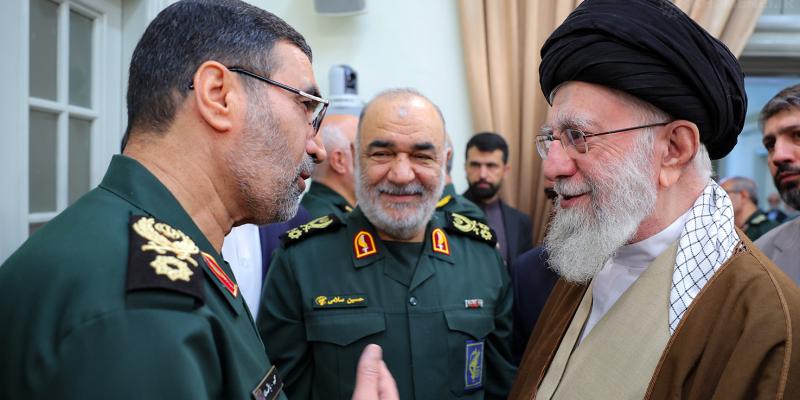
The camera moves among military commanders on the sidelines of one of Iran’s missile exercises, stopping to chat with each of them. The exercise is of great importance, which is why commanders beyond the Aerospace Force are present—from the General Staff of the Armed Forces to the Khatam al-Anbiya (pbuh) Central Headquarters and the IRGC’s top command. The camera eventually reaches the man whose subordinates’ performance has drawn all these military officials into the middle of the desert. Yet the Aerospace Force’s missile commander refuses to appear on camera. The cameraman persists and refuses to leave him alone. In the end, all he manages to extract from the commander is a single sentence:
"When we are martyred, then go interview my family!"
That is all that Brigadier General Mahmoud Bagheri says, half-jokingly and with courtesy, as he slips away from the camera’s frame.
In many ways, that was Bagheri’s entire life. Always fleeing from cameras, media attention, interviews, and public recognition. One reason so little information is available about him, even after his martyrdom, is precisely this. Those familiar with the field, however, know that throughout the last four decades, the imprint of Bagheri could be found throughout Iran’s missile force: from the days when the missile program was merely a small and fragile sapling, to recent years when it had become one of the largest and most powerful missile forces in the world. A force capable of conducting massive and unprecedented operations, confronting the dense and sophisticated defensive layers of NATO, Israel, the United States, and Arab states.
Operations True Promise 1 and True Promise 2 stand as examples. In terms of scale, scope, and even quality, they can be counted among the largest missile attacks in history. Only a few months ago, Sayyid Majid Mousavi, the current commander of the IRGC Aerospace Force, identified Bagheri as the principal architect and planner behind these operations.
The servant of a mourning ceremony for Imam Hussain (pbuh) in Tehran’s Mehrabad-e Jonoubi district was, in his youth, a physics student at Sharif University of Technology. It was Hassan Tehrani Moghaddam who advised him to change his field of study. Why? Tehrani Moghaddam told him that his education should be directed toward a discipline that would also contribute to the missile organization and its mission.
As a result, his academic path shifted toward civil engineering and surveying. Years later, as a graduate of Khajeh Nasir University, he became one of the key figures in the preparation and ballistic launch calculations of Iran’s missile force. The formation under his command possessed the largest missile arsenal in the region and one of the largest missile forces in the world. Yet many people did not even know who commanded this vast organization. Even during Iran’s missile exercises, which had secured a prominent place among the country’s defense events since the mid-2000s, there was no public image, name, or trace of him.
The commander had conquered his own ego. In some of those missile exercises, cameras, journalists, and reporters had turned toward him, but he treated them exactly as he had treated the cameraman mentioned at the beginning of this account. He remained the same until the day of his martyrdom.
After the True Promise 1 missile operations against the Zionist enemy, he received the Fath Medal from the martyred Leader, an award bestowed upon warriors, military personnel, and commanders who achieve remarkable victories against the enemy. Yet the commander refused to wear it on his uniform. When his child asked why, given that such an honor was the dream of many people, he replied:
"As long as my friends in the organization, who have been my teachers and mentors, have not yet received this decoration, I will not wear it."
Although the commander attained his lifelong wish during the predawn enemy strike of June 13, 2025, after forty years of struggle in the path of God, he had built a structure that continued to function like clockwork even in his absence. The annual missile exercises, the mobilization of the entire force, and the execution of pre-designed and carefully planned scenarios across missile bases throughout Iran all demonstrated their value during the offensive strikes of the 12-Day War and the Third Imposed War.
Martyr Ali Larijani once said of Bagheri:
"He was one of the greatest military assets of the country."
The commander’s years of preparation, organization, and training had ensured that the force he helped build would continue to operate effectively, even without him.
Jun. 23, 2026