Architects of the powerful Iran
A frame of a man who was never in the frame
One.
Palestine was never merely a political, military, security, or professional matter for him. It was also a matter of faith and conviction. He would pray behind Palestinian commanders and fighters. Whenever Palestinian officials and commanders were his guests, he would ask his wife to prepare their favorite foods. The Palestinians were fond of Kufteh Tabrizi, Ghormeh Sabzi, and Ash-e Mast. When Muharram arrived, he would organize mourning gatherings for Imam Hussain (pbuh) at both his workplace and residence. Palestinians attended these gatherings as well. During his years in Lebanon, he would even send food prepared for the mourning ceremonies of Imam Hussain (pbuh) to the homes of his Palestinian friends and their families.
Mohammad Saeed Izadi, or, as he was known among the jihadi circles, Haj Ramadan, once told his wife:
"Whoever works for the cause of Palestine is doing no favor to anyone; working for al-Quds elevates a person."
Two.
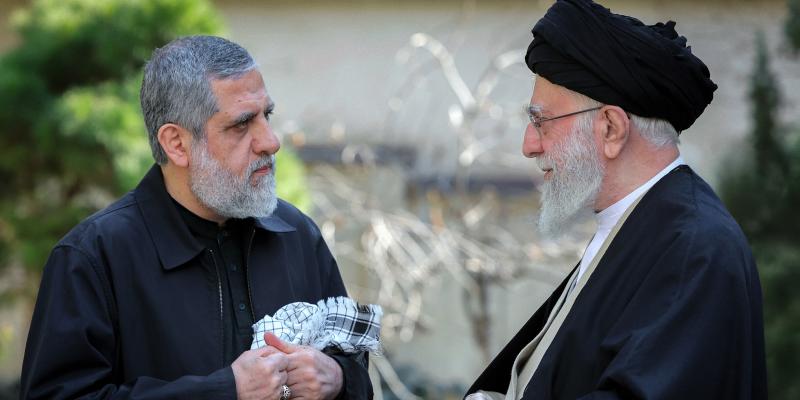
On April 1, 2024, Israel struck Iran’s consulate in Damascus. The body of Martyr Zahedi was transferred from Damascus to Tehran and taken to the Leader’s residence for funeral prayers. Haj Ramadan was present as well.
After leading the prayers, the martyred Leader reportedly said, “Bring Haj Ramadan’s wife.” When she arrived, he told her:
"You share in the rewards of this man."
He then added:
"We love Haj Ramadan, and we still have much work to do with him."
The reserved and introverted commander must surely have felt both honored and embarrassed upon hearing such praise. He had even concealed his military rank from his own family.
Three.
In December 1992, Israel expelled more than four hundred Palestinian intellectuals and activists from Gaza and the West Bank, transporting them by truck to the occupied zone of southern Lebanon, a region controlled at the time by Lebanese militias allied with Israel and which would remain under their control for another eight years.
The exiles settled in an open area near the border and announced that they would not leave until they were allowed to return to their homeland. Israel believed this measure would permanently solve the issue of Palestinian resistance. Instead, something very different occurred.
Haj Ramadan, who had already been stationed in Lebanon for eight years, went to visit them. The photograph of that visit was released by Hamas on the anniversary of his martyrdom.
Four.
The pager incident, followed by the assassinations of Sayyid Hassan Nasrallah and Sayyid Hashem Safieddine, dealt a heavy blow to Hezbollah. Many people, even in Iran, lost hope.
Haj Ramadan, however, had been active in Lebanon since the early 1980s. People knew him, trusted him, and believed in him. He was not even permitted to travel from Tehran at the time, yet he found a way to reach Beirut.
One by one, he sought out officials and commanders from Hezbollah’s various organizational layers. He delivered messages, held meetings, and spoke with them personally. He believed that the Party of God was far too deeply rooted and resilient to collapse from such blows. What was needed was someone willing to provide leadership and reassurance during that difficult moment.
So he rolled up his sleeves and stepped forward himself.
The news spread rapidly:
"Ramadan has arrived."
Five.
He served as a link between the Palestinian factions and the martyred Leader. The Palestinians trusted his honesty and integrity to such a degree that they would entrust even their personal letters addressed to the Leader to Haj Ramadan.
That trust was the product of three decades of brotherly relations between a Shia commander and Sunni fighters.
His wife recounts an interesting memory regarding these exchanges:
"With his permission, I saw some of those letters. They were incredibly heartfelt and emotional. He would show them to me and say, for example, ‘Look at what Mohammed Deif wrote to Imam Khamenei.’ Perhaps even a soldier serving in Iran who loved the Leader deeply would not have written something so affectionate."
Six.
For more than twenty years, the Israelis pursued him. Before his martyrdom, they had already attempted to assassinate him on three separate occasions, all unsuccessfully.
A man who had spent years alongside figures such as Imad Mughniyeh, Mohammed Deif, and Yahya Sinwar understood that when confronting Israel, one must leave no trace behind.
For security reasons, he spent so much time indoors, under roofs, and away from open spaces and sunlight that his vitamin D level had fallen to just five nanograms per milliliter of blood, a figure that should normally exceed twenty. As a result, he suffered from tiny stress fractures in his bones during his final years and endured considerable pain.
Yet even this was merely another cost borne by a man who spent decades living outside the public eye.
The irony was unmistakable: one of the most influential figures in the Palestinian file was also one of the least visible. Haj Ramadan spent a lifetime avoiding cameras, interviews, and publicity. Yet his influence could be found across decades of relationships, institutions, and movements that stretched from Tehran to Beirut, Gaza, and beyond. He was, in every sense, a man who was never in the frame—yet whose presence was visible everywhere.
Jun. 23, 2026