Architects of the powerful Iran
"Why don't you ever get tired?!"
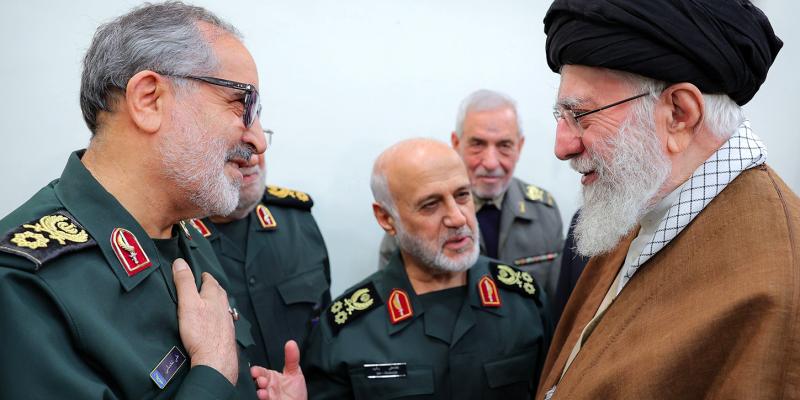
Consistency, consistency, consistency — a seven‑letter word that sums up the life and career of the former commander of the Khatam al‑Anbiya (pbuh) Central Headquarters: Martyr Major General Ali Shadmani, a soldier with 46 years of service. He was the embodiment of gradual, step‑by‑step growth. On June 13, 2025, just hours after the martyrdom of Martyr Rashid, Shadmani assumed command of the war. His career began in 1981, when he took charge of the central front of Sar‑e Pol‑e Zahab. A veteran of that front, he would later command the war against the Zionist regime — succeeding Major General Rashid.
Reading through his step‑by‑step operational record is enough to take one's breath away: Deputy for Operations of the IRGC Hamadan, Commander of the IRGC Paveh, Commander of the 32nd Ansar al‑Hussain (pbuh) Division in Hamadan, Commander of the 6th Special Forces Division (the IRGC's special operations forces for extraterritorial missions), Deputy for Operations of the IRGC Ground Forces, Commander of the 3rd Special Forces Brigade, Commander of the IRGC's Najaf al‑Ashraf Headquarters in western Iran, Commander of the Amir al‑Mu'minin (pbuh) Ground Sciences and Technology University of the IRGC Ground Forces, Head of the Ground Operations Department of the General Staff of the Armed Forces, Deputy for Operations of the General Staff and the Khatam al‑Anbiya (pbuh) Central Headquarters, Deputy Coordinator of the Khatam al‑Anbiya (pbuh) Central Headquarters, and ultimately, Commander of the Khatam al‑Anbiya (pbuh) Central Headquarters.
These are the extensive credentials of a commander who joined the IRGC in 1979. He gradually rose through the ranks, step by step, until he reached the position of commanding the war against the American‑Israeli coalition. An elite graduate — a brilliant officer — of the 1989 Command and Staff course, he left almost no public trace outside the Armed Forces. This was partly due to his personal demeanor, and partly due to the nature of his work. Alongside other commanders, he was involved in designing and shaping Iran's defense and military framework for a future war with the US and the Zionist regime. It was only in the mid‑2010s that his name first appeared in media headlines, when he made brief references to the depth of the Resistance Front's defensive layers.
He had once said that during the 8‑Year Imposed War, Iran was only able to organize a portion of Iraqi Kurds in the north of that country against Saddam — but now, in Lebanon, Palestine, Syria, Iraq, and Yemen, people eager to fight against Global Arrogance have joined Iran. The words of a commander who had until then remained out of spotlight suddenly made headlines across many domestic and foreign media outlets. It was a bold statement. The Deputy for Operations of the General Staff of the Armed Forces had declared that Iran's operational front now extended from the Arvand River to Bab el‑Mandeb. The commander had stepped out of the shadows only after years of continuous work by him and his comrades — when their plans had finally been implemented and operationalized on the ground, from Arvand to Bab el‑Mandeb!
In June 2025, Ali Shadmani was a soldier with 46 years of service. The war had begun with the martyrdom of his commander, Gholamali Rashid. On June 13 — the very day the war started — the martyred Leader conferred the rank of Major General upon Shadmani and issued his appointment as Commander of the Khatam al‑Anbiya (pbuh) Central Headquarters. The veteran soldier of the Armed Forces, whose career had begun with clashes against counter‑revolutionary forces in 1979, was now the commander of the country's wartime headquarters. The martyred Commander‑in‑Chief had told him that he had seen his name mentioned in a book by Hamid Hessam about the people of Hamedan during the Sacred Defense — a book that referred to Martyr Hasan Tork.
The martyred Commander‑in‑Chief's reference was to a time when the man who would later command the wartime headquarters had been a simple soldier in a sector commanded by Martyr Hasan Tork. That same simple soldier was now at the helm of the war against the Revolution's and the country's primary enemies. Shadmani had run for 46 years. For 46 years, he had never taken his boots off. For 46 years, he had kept his eyes open, surveilling the enemy, planning, and aligning the Armed Forces according to the threats — and most importantly, for 46 years, he had never grown tired. When he was martyred on June 25, 2025, he received the reward for all those 46 years at once. There is an important question that should be asked of Shadmani and his comrades: "Why don't you ever get tired?!"
Jun. 20, 2026