Architects of the powerful Iran
"Where do you get this resolve from?!"
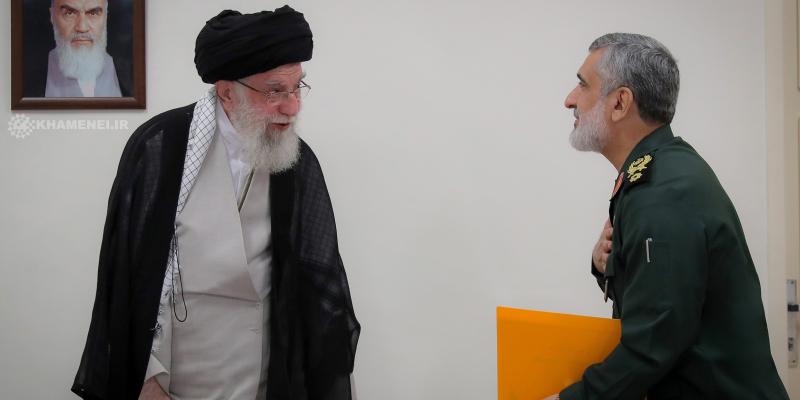
On February 5, 2004, the public relations office of the Ministry of Energy sent a news release to the media announcing the start of tunneling for the country's largest water transfer project. Among the names mentioned in the text, from the then‑minister of energy to others, was that of an IRGC commander: Commander Hajizadeh! Hajizadeh's share of the 100‑word release — in which the Ministry's public relations office referred to him as Second Brigadier General Engineer — was just one paragraph: "We have tried to prepare the ground within the IRGC for the implementation of this project. To transfer new tunneling technologies, 18 personnel have been dispatched abroad, while specialists with expertise in this field have also been recruited. We hope to complete the two 18‑kilometer tunnel sections under our responsibility in less than three years."
Few people probably knew what the real job of this 42‑year‑old IRGC commander — now a project contractor — actually was. A deputy to Martyr Hassan Moghaddam, he had been dispatched to Syria for missile training alongside him in 1984. Upon returning home, he became one of the most important pillars of the IRGC's newly established missile unit until the end of the 8-Year Imposed War. Once the war was over, they scoured every inch of Iran for one purpose: building IRGC missile bases inside mountains! By the time he came to assist the Ministry of Energy in 2004 as Second Brigadier General Engineer Hajizadeh, he had already gained extensive experience in tunneling. He and his comrades had launched a major national project, transforming the depths of numerous Iranian mountains into missile silos and underground missile cities. Now, in the cold of February 2004, he had come to share his and the IRGC's tunneling expertise with the Ministry of Energy — to transfer water from one part of the country to another.
He, along with the capabilities and skills of his organization, was at the forefront of moving toward grand ideas. The wall of problems, obstacles, and "impossibilities" that he and his comrades broke down became experiences they shared with others. After that, others gradually found the courage and belief that it could be done. The water transfer tunnel was not the only case. In 2009, the IRGC Air Force and the Missile Unit were merged. The name chosen for the newly established force once again signaled an ambitious idea — an idea that was, of course, commensurate with the resolve of Hajizadeh and his men: the IRGC Aerospace Force. Three years later, in 2012, alongside missile and drone commands, the force's space command also began its work. Hajizadeh and his men had set their sights on conquering space and the 500‑kilometer orbit, so that the surplus of defense and military capability could also be placed at the service of civilian sectors — much like what they had done for the water transfer tunnel project in February 2004.
Eight years later, in May 2020, the Noor‑1 satellite was launched into space by the Aerospace Force's space command, followed by Noor‑2 in March 2022 and Noor‑3 in October 2023. The backbone of these satellite launches was the very missiles that, in a different context, were meant to defend Iran against its enemies. The missiles themselves had already seen limited action against ISIS and US interests in Ain al‑Asad in October 2018 and January 2020. But it was Operations True Promise 1, 2, 3, and 4 that showcased the power and resolve of the IRGC Aerospace Force's missile arsenal. The 42‑year‑old commander of February 2004 was martyred in the early hours of the 12‑Day War at the age of 64 — yet the structure he had built ensured that no command vacuum would disrupt the response to the enemies.
What unfolded during the Third Imposed War against American bases in the region demonstrated that the resolve of a commander who had joined the IRGC in 1980 had permeated the entire structure of the force under his command. A resolve that had once subdued the hard layers of earth beneath towering mountains, and had once conquered the 500‑kilometer orbit, and during the Third Imposed War, even in the absence of its commander, brought down American bases, radars, and AWACS of all sizes across the region. Hajizadeh and his men were the embodiment of that famous saying of Martyr Hasan Tehrani Moghaddam: "Only weak people work within the limits of their capabilities!" If only one could sit down with these men and ask them: "Where do you get this resolve from?!"
Jun. 21, 2026