Martyr Khamenei regarded the issue of Palestine as the heart of the Muslim world
Mr. Khaled Qaddoumi, Hamas’ representative in Tehran
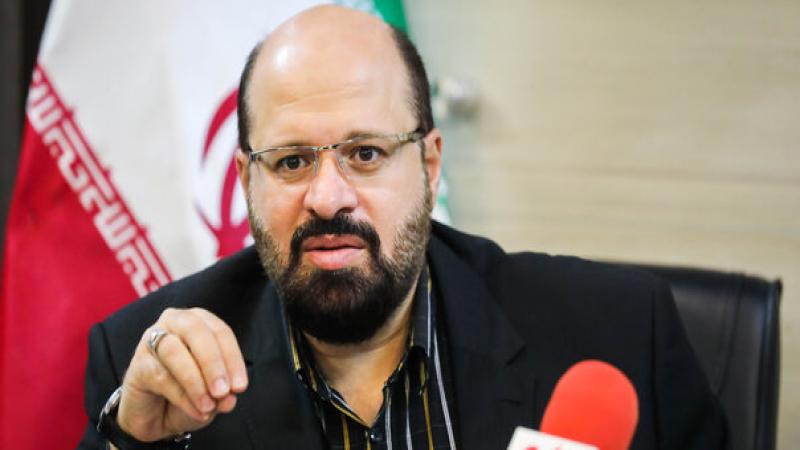
Khamenei.ir’s interview with Mr. Khaled Qaddoumi, Hamas’ representative in Tehran, highlighting key aspects of the martyred Leader of the Islamic Revolution's vision on Palestine, his decades-long support for the Resistance, and his strategy in reinforcing Palestine’s centrality in the Islamic ummah.
Question: In your opinion, what was the distinctive feature of Martyr Khamenei’s perspective on the issue of Palestine?
Khaled Qaddoumi: Ayatollah Khamenei (may God sanctify his soul) regarded the issue of Palestine as the heart of the Muslim world. At the core of this world, he placed Quds, and at the heart of Quds, he saw the Resistance—particularly groups like Hamas and other Palestinian resistance factions. Whenever he spoke of supporting the Palestinian cause, he consistently emphasized that all Muslims carry a deep love for Palestine in their hearts and desire to support it. Therefore, this cause could serve as a unifying factor for all movements. In fact, this was a legacy passed down from the founder of the Islamic Revolution [Imam Khomeini (ra)]. The concept of “International Quds Day,” observed on the last Friday of Ramadan, was itself a unifying idea for the Muslim world, centered around the noble and righteous cause of Palestine.
At the last Non-Aligned Movement summit held in Tehran, he stressed the need for unified efforts, not only within Islamic countries but also among all nations that seek to support Palestinian rights and stand with the oppressed. He reminded them of their human duty to unite in support of the Palestinian cause. He also posed the question: Why should the Palestinian people be denied the right to determine their own destiny, when this is their most natural and inherent right?
Therefore, there is no doubt that Imam Khamenei (ra) called for the convergence of efforts from all peoples, supporters, and Islamic countries. He believed that the issue of Palestine represents the best axis for achieving unity among Muslims – uniting them in support of this cause and in confronting the Zionist regime.
Question: How have Martyr Khamenei’s views and actions over the past four decades of his leadership impacted the Palestinian cause?
Khaled Qaddoumi: There are numerous stances taken by the late Imam Khamenei (ra) in support of the anti-Zionist resistance. As mentioned earlier, one of his significant views was the open and expansive approach he had towards paths that could, from a technical or strategic standpoint, make the Zionist enemy vulnerable. In his speeches, addressed to the world, humanity, and various generations, he consistently referred to the Palestinian issue as a topic that could unite the righteous factions of humanity against the evil powers, the Zionist regime, and the American-Zionist imperialism.
The clarity and sharpness of his vision were completely evident in his personality – he was at once a profound thinker and a practical man of action, both a soldier and a commander on this path. As previously mentioned, he greatly admired Martyr Ismail Haniyeh.
Question: As you know, Martyr Khamenei, the Martyr of Quds, placed significant emphasis on the relationship between the Islamic Republic and the anti-Israeli Resistance groups. Do you have a particular memory or event related to this that you could share with us?
Khaled Qaddoumi: A few years ago, when Hajj Abul-Abd [Martyr Haniyeh (ra)] was still in Gaza and unable to leave, and had been absent from meetings for some time, a delegation led by the great Martyr Sheikh Saleh Al-Arouri (ra) was formed to visit the Islamic Republic. When we met with the Leader and Hajj Abu-Mohammad presented the letter from Hajj Abul-Abd to him, the Leader’s reaction was quite astonishing. Picture this: He read the entire two pages of the letter aloud, word for word, right before the delegation, as if he were speaking directly to his martyred brother, Abul-Abd.
He was profoundly moved by the letter and once again reaffirmed his full support for the Palestinian nation. He also reminded us that one of the key initiatives proposed by Martyr General Qasem Soleimani was to define the role of the Islamic Ummah regarding the Palestinian issue. This was a significant plan that led to the tremendous confrontation and resistance led by the faithful and mujahid Palestinian youth against the Zionist enemy.
There are many other instances and actions —perhaps there is no time to mention them right now, but undoubtedly history will testify that this devout and faithful man never faltered and spared no effort in supporting his brothers in Palestine and advocating for the Palestinian cause.
We ask for God’s mercy upon this Mujahid scholar—an individual who knew the path and understood how to leave this world while humbly standing before Almighty God. Yet, at the same time, he gave something great in support of the religion and the Palestinian cause.
We remember this man and this commander with all the meanings of love, resistance, and dedication to the cause of religion, Islam, and humanity in Palestine.
The martyrdom of Imam Khamenei (ra) was a great loss for the Palestinian cause. However, our hope is that this great Leader has left a legacy upon which the third Leader of the Islamic Revolution, Sayyid Mojtaba Hosseini Khamenei (may God protect him), will continue to tread. A legacy that will remain a thorn in the side of the Zionist and American criminals and will continue the path begun by the founder of the Islamic Revolution in supporting the oppressed and defending the Palestinian cause.
Question: The Martyred Leader had stated that the entire Arab and Islamic world should support Palestine and the Palestinians without expecting anything in return. How did his actions and relationships with the Resistance Movements and Palestine manifest? Did he have any specific expectations from you?
Khaled Qaddoumi: When a believer passes away, two places weep for him: one in the heavens where his deeds used to ascend, and one on earth where he used to pray. Yes, even the place where a person worshipped God feels his absence and weeps for him. Some books on spirituality even mention that the earth weeps for a scholar for forty mornings after his passing.
The martyrdom of the Leader, Ayatollah Sayyid Ali Hosseini Khamenei, represents the loss of a committed scholar, a true Mujahid, and a helper to the oppressed, as he ascends from this earth to the heavens. He had repeatedly expressed his longing for martyrdom and his desire to give his life in defense of Quds. Even in his final speech – one that seemed like a farewell – he emphasized this point, urging the people, his students, and his followers worldwide to stand firm against Western culture and the forces of Global Arrogance. He called on them to become a blazing torch and a sharp sword in safeguarding and defending Quds, and to continue the path of struggle for the annihilation of the criminal Zionist regime.
The late Leader had a special place for Palestine in his thoughts, heart, and mind. For him, Palestine was not just a historical issue or a passing phrase; it was a belief, a religion, a duty, and a faith. He inherited the issue of Palestine from the founder of the Islamic Revolution, Imam Khomeini (ra), and called on the people to confront the criminals, the oppressors, and the Arrogant Powers.
In his writings, speeches, and private meetings, Imam Khamenei (ra) consistently emphasized and encouraged support for Palestine and the Resistance. His relationship with the advocates of the Palestinian cause – whether they were Palestinians or non-Palestinians, Muslims or non-Muslims – was truly unique. We remember that in his message addressed to the youth of Europe, he clearly stated that Palestine is an oppressed nation and that this is a humanitarian issue.
This concept must always be remembered, because despite his deep faith in the religious and ideological aspects of the Palestinian cause, the late Leader emphasized that Palestine is a humanitarian issue and one that is linked to the security of the entire world. He always spoke about Palestine in various dimensions.
In my opinion, what sets his statements about Palestine apart can be summarized in a few key points: First, his clear sense of direction. He always believed that the path of everything – culture, society, and politics – leads to Quds, as he viewed Quds as the first qibla of Muslims and a central element that anyone with humanity should be drawn toward. He regarded the enemy occupying the Palestinian land as an enemy of all humanity, not just the Palestinians. The Martyred Leader consistently pointed to the security and humanitarian threat arising from these criminal aggressors.
The second point about the Martyred Imam’s view on Palestine is that he was not just a political analyst or a religious preacher; he was a missionary of Islam. The profound humility in Ayatollah Khamenei led him to draw all his determination from the steadfastness of the Palestinian fighters in order to interpret the human dimensions [of their struggle]. I remember that my last meeting with him was on the day of the martyrdom of Commander Ismail Haniyeh.
He warmly welcomed him, and before delving into political discussions, the main point he raised in welcoming Martyr Abu Abd and his accompanying delegation was: “I am a propagator of Islam, and I have experienced all religious and Islamic theories in inviting people to the faith; in some cases, we were successful, and in others, we were not. But what did you do in Operation Al-Aqsa Flood that caused non-Muslims to turn to the religion of Islam?”
He mentioned that he had received reports from religious centers in Europe indicating a strong inclination toward Islam because of Operation Al-Aqsa Flood. He was full of this experience and very pleased that the children of Palestine had become the flag bearers of defending the Islamic Ummah. Therefore, he decided and was determined to stay with them, assist them, and be their partner – not just their supporter, but their partner. Thus, Ayatollah Khamenei’s perspective on Palestine was a global, practical, and jihadist one, coupled with the conviction that the true qibla is directed towards Palestine and Quds.
The truth is that the martyrdom of this great man – the wise Leader of the Islamic Revolution – was, on the one hand, as I said, the fulfillment of wish, and on the other hand, we are filled with sorrow at the loss of this man – a man to whom we are greatly indebted because of his steadfastness in standing by the Palestinian cause, in the trench of martyrdom. He was truly a martyr in the cause of Al-Aqsa Flood and Al-Quds. May God have mercy on him. I pray that the Almighty accepts him among the righteous people.
Mar. 15, 2026