

“Hikayat al-Sayyid” unveiled at Keshvar Dost Street: A book that narrates the upbringing of a Leader
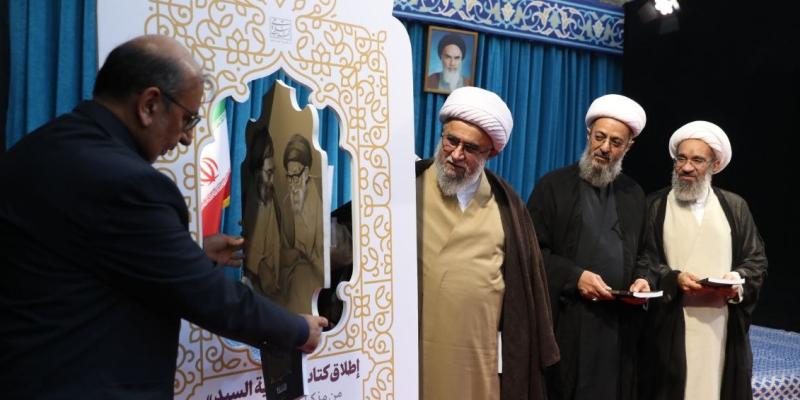
The unveiling ceremony of the Arabic translation of the book "Agha's Narrative" under the title "Hikayat al-Sayyid" was held on the evening of Thursday, May 14, 2026, beside the site of the martyrdom of the martyred Leader of the Islamic Revolution, in the presence of Arab scientific and cultural figures residing in Iran.
The book "Hikayat al-Sayyid" explores the upbringing and formation of the personality of the martyred Leader, narrating his family relationships, methods of upbringing within the household, and the spiritual and cultural atmosphere that shaped his life. Given the position of the martyred Leader of the Revolution in the world — especially among Arabic-speaking audiences — many admirers have long sought to understand how this exceptional figure attained such profound scholarly, spiritual, and intellectual stature. Through this book, the path toward that understanding has become clearer.
During the ceremony, Dr. Mohammad Akhgari, Deputy for World Service of the Office for the Preservation and Publication of the Works of Grand Ayatollah Khamenei, stated: “Today, in a place where memory has become intertwined with martyrdom, we stand with utmost respect before the remembrance of a personality who left a profound impact upon hearts and souls through his knowledge and sincerity. Our gathering today for the unveiling of the Arabic translation of Agha’s Narrative has granted this place a unique spiritual and cultural dimension.”
He added: “'Hikayat al-Sayyid' is not merely the story of the life of a great scholar, but rather a truthful window into the personality of a man who exercised a profound educational and intellectual influence upon the Leader of the Islamic Revolution. Through the memories of a righteous son — the martyred Leader, Grand Ayatollah Sayyid Ali Hosseini Khamenei — the book presents a vivid and authentic image of that great father and opens before readers a treasury of moral, spiritual, and educational values.”
During another part of the ceremony, a televised message from the Bahraini Shiite authority, Ayatollah Sheikh Isa Qassim, was broadcast.
In his message, Ayatollah Qassim referred to the dimensions of the personality of the martyred Imam of the Islamic Revolution and described today’s war as “a battle between the camps of jahiliyyah and faith.” He emphasized that Imam Khamenei (may God sanctify his soul) was “an outstanding revolutionary figure distinguished by vigilance, unwavering determination, and exceptional strategic capability.”
Ayatollah Qassim added: “The entire being of Imam Khamenei was immersed in the principles of that great, dignified, and divine Revolution. Following the passing of Imam Khomeini (ra), Imam Khamenei was the worthy successor in leading the victorious Islamic government and truly completed the glorious path of that Revolution’s success.”
Describing the martyred Imam as “a capable, effective, and diligent man in restoring the Ummah sincerely and truly to Islam,” the Bahraini Marjaʿ noted: “He succeeded in preserving the unity of the Islamic Ummah upon its correct course in accordance with Islamic teachings, righteous upbringing, constructive goals, and the successful policies of this noble religion.”
Ayatollah Sheikh Hussein al-Maatouq, the prominent Kuwaiti scholar and seminary teacher, also addressed the gathering, stating: “At these moments and in this blessed place, we gather to recount what Imam Khamenei said about his father — that divine scholar, mujahid, ascetic, pious jurist, and faqih.”
Speaking about the features of "Hikayat al-Sayyid," he explained: “By reading this book, one first becomes acquainted with the influence of that father in creating a faithful, pure, and righteous environment for his children, for he was among those who helped establish the atmosphere from which the blessed Islamic Revolution emerged.
One also comes to understand an important dimension of Imam Khamenei’s personality and the environment in which this great scholar was nurtured — an environment that embraced Islam, understood Islam, lived Islam, and lived in constant connection with Almighty God.”
Regarding the personality of Imam Khamenei, Ayatollah al-Maatouq stressed: “We stand before a personality who represents the practical embodiment of the saying of the Prophet (pbuh): ‘The scholars are the heirs of the prophets.’ This model of the heirs of the prophets is not among those scholars who live without responsibility. Rather, he is the scholar intended by the Messenger of God — one who understands and carries his responsibility toward Islam and humanity and fulfills his role with dignity and honor. Martyr Imam Sayyid Ali Khamenei was indeed a continuation of the path of the prophets.”
Ayatollah Reza Ramezani, Secretary-General of the Ahl al-Bayt (pbuh) World Assembly, also addressed the event, noting that humanity today faces three distinct styles of life. He explained: “One style is based on a secular worldview in which religion has no role in society and is confined only to personal life. The second is an atheistic lifestyle grounded in the denial of God, monotheism, and the Hereafter, leading naturally to a materialistic existence. The third is the believing and faithful way of life.”
He added: “We must introduce models to humanity demonstrating that one can live in today’s world while remaining monotheistic, spreading love throughout human society, and standing against wealth, power, and oppression. A true believer must be both a manifestation of mercy and a manifestation of divine wrath against injustice.”
The member of Iran’s Assembly of Experts further emphasized that the memories contained in the book reveal that the father of the martyred Leader was exemplary and influential in self-purification, family conduct, and relations with companions. “He was simultaneously a father, a teacher, and a mentor. This demonstrates that anyone wishing to influence human society must first undergo the path of moral refinement and spiritual discipline. One who is not himself refined cannot refine others.”
Hujjat al-Islam Sheikh Moein Daghigh, Hezbollah’s representative in Qom, also spoke during the ceremony, declaring: “We stand within a sanctuary of purity and sanctity. Before entering this place, one must cast aside weakness and despair and clothe oneself in dignity, strength, and courage. From this very place, statements of insight were issued; from this very place, the Ummah was guided; from this very place, strategies were drawn and the affairs of the Islamic Ummah administered. From this place, our great Leader called humanity toward the Book of Almighty God. What immense love it is to stand here and speak while mourning such a great martyr.”
The prominent seminary scholar added: “The world today exists in a moment of profound influence and transformation. Humanity wishes to know who this leader was — the man against whom all the tyrants of the earth united in order to assassinate him, believing that through his martyrdom they could destroy the civilization of Islam in this country and eliminate the Resistance Front. Yet they failed.”
He continued: “Today more than ever we need Hikayat al-Sayyid and the pure Muhammadan Islam it represents so that its message may reach all nations and peoples. The enemies today seek to overturn values and standards and to dominate human societies through the corrupt values of Epstein Island.”
The ceremony also featured poetry recitations by Sayyid Morteza Heydari Al Kathir, the Arab poet from Khuzestan, dedicated to the martyred Leader of the Islamic Revolution.
An atmosphere of tears and personal tributes beside the site of the martyrdom of the Martyr Khamenei
What distinguished the event from an ordinary cultural gathering was the emotional atmosphere surrounding it. All Arabic-speaking participants were given sheets of paper upon which they were invited to write personal messages to the martyred Leader in their native language. Men and women holding pens in their hands were often seen with tearful eyes, grieving either the loss of their religious and spiritual leader or mourning the political leader of the Islamic Ummah.
The most emotional moments came when recordings of the speeches of the martyred Leader in Arabic echoed throughout the Keshvar Dost Street near the site of his martyrdom.
Many Arab guests, deeply moved by the atmosphere, felt themselves standing beside the man who for years had guided the Ummah from the end of Palestine Street in Tehran.
May. 14, 2026