Analysis
When the women of Kashmir gave Iran everything they had
Zeinab Nadali, journalist
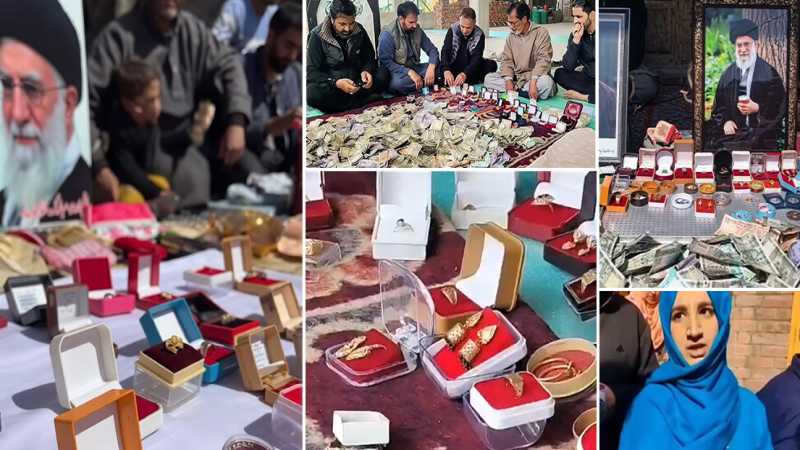
While many women in Kashmir don’t even own a single piece of gold, a line of women, girls, and even children has formed, ready to give their most valuable belongings to Iran and its people.
“Few women in Kashmir own gold.” The poverty is clear from Mohammad Shafi’s very first words — but soon, that same poverty leaves you in awe. You see women standing in long lines, offering their small pieces of gold, whatever little they have, to help Iran and fight against the Zionist regime.
Mohammad Shafi, who has witnessed these scenes firsthand, speaks of women who have endured years of hardship in Kashmir — women with sunburned faces and hands worn by labor and the struggles of life. And yet, many of them are giving away their savings, meant for hard times, to fight oppression — to stand firm against the Zionist regime.
As Mohammad Shafi puts it, perhaps this is the true meaning of resistance: beliefs so powerful that geographical borders become meaningless. One day, the women of Yemen send their gold to Palestine; another day, Iranians send theirs to Lebanon. And now, the women of Kashmir are taking their modest belongings out of their safes to heal the wounds of Iran’s bombed areas. In all of this, it is the women who carry the flag of solidarity and resistance, leading the way for everyone.
Mohammad Shafi believes that resistance knows no age. Like the one-year-old girl who brought her savings jar for Iran, or the little girl who takes off her earrings. When asked why she’s giving them away and to whom, she replies: “I’m giving these to Iran — for the students who were martyred, to rebuild the school in Minab.”
A common sight In Kashmir these days is young girls gently reaching for their ears, removing their small earrings, and confidently offering them for Iran. As Mohammad Shafi puts it, the true adornment of these girls’ ears is their love of freedom and their spirit of independence.
That’s why, if you scroll through social media, you’ll find dozens of videos of young girls either bringing their earrings to donate or breaking open their savings jars, holding out their small fists filled with folded bills.
But few may realize that behind every little savings jar lies a world of childhood dreams — a savings jar filled over months with small bills, meant one day for a new bicycle, a beautiful doll, or a princess dress.
You may ask yourself: what is this generosity all about? What do these women, girls, and even children want in return for their most valuable possessions? I asked Mohammad Shafi the same question. Instead of answering himself, he sent me a video of a young girl donating her gold, saying: “Our only wish is that Iran wins — nothing else.”
You should know that for them, this is not just financial aid. It’s a decision that sometimes means parting with the most precious memories of their lives. Like the elderly woman who wrapped her gold in a cloth and brought it with her. She said: “My husband passed away twenty-eight years ago. This gold is his keepsake, and I hadn’t touched it all these years. But today, I’ve brought it to donate for Iran.”
Or like the grandmother holding her old, folded savings tightly in her hand. When asked why she was doing this, she firmly replied: “If Iran needs it, I would give my house, even my family. I’m ready to sacrifice everything.”
My story returns to Mohammad Shafi’s first words: “In Kashmir, few women own gold. Usually, the only valuable things you find in some people’s homes are the copper pots they use every day.” That’s why, among the children’s savings jars and the women’s gold, you will also find many copper pots — gifts from the women of Kashmir to Iran.
Then he sent me a picture of a woman wiping her tears with the edge of her scarf — tears of longing. She said: “If I had gold, I would have donated that too. But all I have are these copper pots — the ones we use to make tea and eat breakfast.”
The truth is, the women of Kashmir gave everything they had, without hesitation — their entire wealth. Perhaps in the world’s cold and calculating eyes, there is no obvious logic or justification for what they did. But these unknown people, scattered across the world — the very ones who may seem weak and powerless in the eyes of the great capitalists — will one day be the ones to uproot arrogance and oppression.
It Is humble and generous people, with their big hearts, who turn the world into a paradise; and the best example of this are the people of Kashmir.
Apr. 5, 2026