

Revisiting the martyred Leader of the Islamic Revolution’s stances on Bosnia:
Book on Bosnia through the eyes of Martyr Imam Khamenei unveiled in Sarajevo
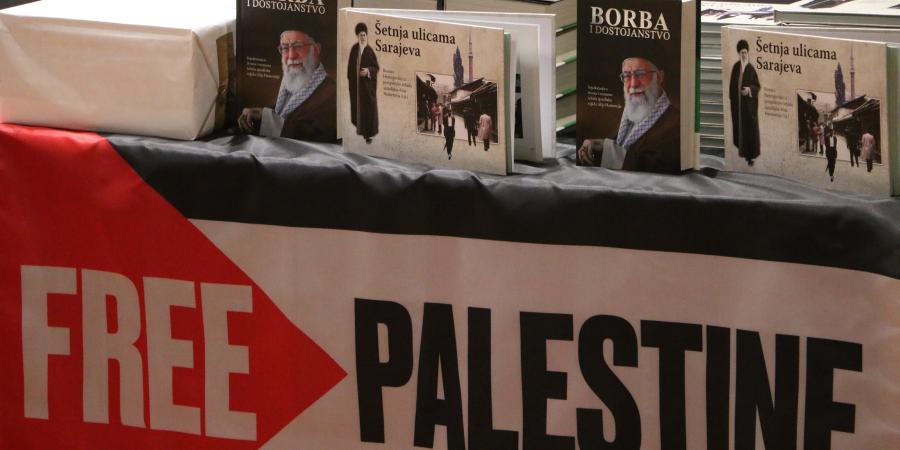
The illustrated book Walking the Streets of Sarajevo: Bosnia and Herzegovina Through the Eyes of Martyr Ayatollah Khamenei was unveiled and introduced at an event in Sarajevo on October 24, with figures from Bosnia and Herzegovina, Turkey and the UK in attendance.
In a message marking the publication of Walking the Streets of Sarajevo, Ayatollah Ahmad Jannati, secretary of Iran’s Guardian Council and the martyred Leader of the Islamic Revolution’s representative for Bosnia and Herzegovina, stressed that the martyred Leader had always felt a sense of responsibility for the fate of Muslims and the oppressed around the world, and regarded support for the people of Bosnia as a duty toward the Muslim Ummah.
In another part of his message, Ayatollah Jannati emphasized the need for Muslim unity in the face of threats and aggression, stating: “All Muslims, and indeed all freedom-loving people around the world, must respond to these crimes with greater unity and resolve than ever before.”
Speakers at the event also revisited memories of the Bosnian War, highlighting Martyr Ayatollah Sayyid Ali Khamenei’s role in supporting the country’s Muslims and underscoring the importance of preserving the history of Iran-Bosnia relations. They also shared their recollections and experiences of the public and international support extended to the country’s Muslims.
Noureddin Şirin, director of Turkey’s Quds TV network, referring to his meetings with Ayatollah Sayyid Ali Khamenei in 1986 and 1992, stated that during a visit to Iran in 1992, amid the Bosnian War, Ayatollah Khamenei called on Muslims around the world to come to the aid of the people of Bosnia by drawing on all available political, economic, military and social resources.
He added that following this call, groups of Turkish volunteers traveled to Bosnia to defend the country’s Muslim population, some of whom were martyred or wounded during the war.
Arzu Merali, a UK-based writer and journalist, also spoke at the unveiling of Walking the Streets of Sarajevo, saying: “The events of the Bosnian War had a profound and lasting impact on the lives and intellectual formation of many young Muslims in Britain.”
Referring to her research into Ayatollah Sayyid Ali Khamenei’s thought and speeches, she stated: “An examination of his positions on Bosnia shows that his support for the people of this country reflected two important aspects of his character: a deep appreciation of the cultures and civilizations of different peoples, and a sense of responsibility toward the oppressed.”
Merali noted: “Ayatollah Khamenei was familiar with Persian literature and the works of prominent writers from around the world, including Victor Hugo and Leo Tolstoy. In his view, different cultures share common human bonds, and support for the oppressed should not be limited by national or religious boundaries.”
The writer and journalist stressed: “Ayatollah Khamenei’s support for the people of Bosnia was not confined to political statements and speeches, but was also accompanied by practical measures and the provision of the resources they needed.” She also described the experience of the Bosnian War as a precursor to the emergence of a movement that later became known as the Resistance Front.
Massoud Shadjareh, chair of the Islamic Human Rights Commission in London, also recalled the activities of Muslims in Britain during the Bosnian War. He noted that Martyr Ayatollah Sayyid Ali Khamenei’s call to support the people of Bosnia played a major role in mobilizing Muslims and volunteers from various countries to assist the Bosnian people.
Referring to his membership in the Muslim Parliament of Great Britain at the time, he stated: “At a time when international organizations were taking no effective action to prevent the massacre of the people of Bosnia, groups of Muslims in Britain were working to raise funds and transport equipment to the country.”
Comparing the experience of the Bosnian War with current developments in Palestine and West Asia, the chair of the Islamic Human Rights Commission stressed the need for solidarity and practical action in support of the oppressed, saying: “The experience of Bosnia showed that confronting oppression requires a sense of responsibility, unity and a willingness to make sacrifices.”
Bosnian political and social activist Demir Mahmutćehajić also spoke at the event, highlighting the importance of publishing Walking the Streets of Sarajevo. He stated: “This book is important not only for Iranians but, first and foremost, for the people of Bosnia and Herzegovina, so that they can learn what Ayatollah Khamenei said about them and their struggle.”
Recalling his own memories of the Bosnian War, he added: “If it had not been for Iran, we would not exist today.”
While acknowledging that some of the memory of Iran’s support had faded in Bosnian society, Mahmutćehajić explained: “This is partly because the Islamic Republic of Iran provided assistance to the people of Bosnia without conditions or expectations of anything in return.”
He added: “Ayatollah Khamenei regarded support for the people of Bosnia not as voluntary assistance, but as a religious and humanitarian duty. Accordingly, the Islamic Republic of Iran, too, viewed its support for the people of this country as the fulfillment of its responsibility.”
Dr. Mohammad Akhgari, deputy for international affairs at the Office for the Preservation and Publication of the Works of the Leader of the Islamic Revolution also addressed the event in a video message. He described Walking the Streets of Sarajevo as a work that brings together art, human conscience and Islamic responsibility, saying: “By revisiting the words of Martyr Ayatollah Sayyid Ali Khamenei, this book recounts aspects of the realities of the Bosnian War and the Iranian people’s support for the people of this country.”
Referring to Martyr Ayatollah Khamenei’s positions during the Bosnian War, Akhgari stressed that this support was rooted in a sense of Islamic responsibility, a commitment that, in his words, “connected the streets of Tehran to the heart of Sarajevo.”
Akhgari also described the book as a record of the silence of international bodies and organizations that claim to defend human rights in the face of the genocide of Bosnian Muslims. He expressed his appreciation to the event’s organizers and everyone involved in publishing the book.
The book Walking the Streets of Sarajevo: Bosnia and Herzegovina Through the Eyes of Martyr Ayatollah Khamenei brings together his statements and views on Bosnia and Herzegovina, the war in the country, and support for its people. Published to revisit these positions and pass them on to younger generations, the book features photographs documenting the Islamic Republic of Iran’s assistance to Bosnia and Herzegovina during the war. It was published in Bosnian by Algorithm Publishing.
The book’s introduction states: “For the sake of the future, it is important that we do not forget the past. This book preserves the lessons, guidance and advice given to us in Bosnia and Herzegovina. This book must be read, studied and heard.”
The book’s chapter headings include “Signs, Remnants and Islamic Sentiments in Bosnia,” “The West’s Crusading Motives Under the Guise of Democracy,” “Being Muslim: The Crime of the Bosnian People,” “A Bright Future for the Muslim People of Bosnia and Herzegovina,” and “Efforts to Preserve Islamic Identity in Europe.”
Oct. 25, 2026