Interview
Interview with Sayyid Javad Nasrallah
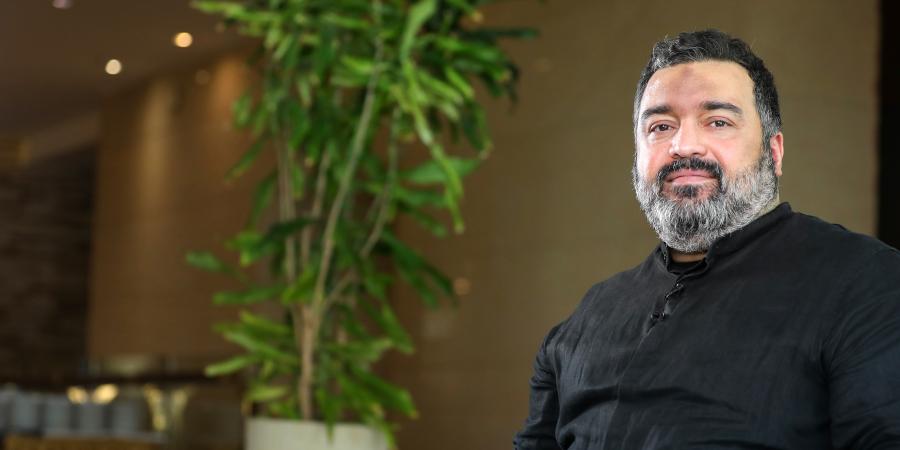
The visit of Sayyid Javad Nasrallah, son of Martyr Sayyid Hassan Nasrallah, to Iran for the funeral of the martyred Leader of the Islamic Revolution, provided an opportunity to sit down for a conversation with the eldest son of the Sayyid of Resistance. This detailed interview covers untold aspects of Martyr Nasrallah's personal and family life, as well as his relationship with the martyred Leader of the Islamic Revolution, Martyr Imam Sayyid Ali Khamenei — a relationship marked by profound spirituality, mutual affection, and enduring devotion. In another section of the interview, Sayyid Javad Nasrallah elaborates on the current state of the Islamic Resistance in Lebanon and the victorious Hezbollah.
Question: Mr. Nasrallah, thank you very much for taking the time to speak with us. Are you the eldest child in the family?
Sayyid Javad Nasrallah: In the Name of God, the Compassionate, the Merciful. I am the second child in the family, after Martyr Sayyid Hadi. After me comes my sister Zainab, then Muhammad Ali, and then Sayyid Muhammad Mahdi.
Question: What year were you born?
Sayyid Javad Nasrallah: May 24, 1981 — about 45 years ago.
Question: What is the earliest image you have of your father in your mind?
Sayyid Javad Nasrallah: I remember that before going to school, I would go to his bedroom and see him sleeping with his hand tucked under his face. Interestingly, a few years ago — before Sayyid's martyrdom — I asked my mother whether my memory was weak, or whether I really hadn't spent many days with my father during childhood and adolescence. She told me that the truth was that he was rarely home. That's why I would go to his room in the mornings before school. He was always in villages, camps, or places of work and outreach. If he did come home, it was late. We would leave for school in the morning while he was still asleep, and then he would wake up early and head out again to continue his daily work.
That said, sometimes he made up for his absence when we were young. For example, when he had work outside the office, he would take us along. I used to tell him, "If this is the kind of work you do, then have more of it!" Sometimes we would go to the heights of Baalbek — a place where he and his companions were known to sit outdoors and hold meetings.
Question: What was the relationship between your parents like at home? What role did your mother play in family life?
Sayyid Javad Nasrallah: I can say that my father's relationship with my mother, Umm Hadi, was a model of respect, love, and courtesy. If I were to sum it up in one sentence, their life together was an Islamic, Alawi, and Fatimi example. We never heard them raise their voices, and we never saw any disagreement, argument, or — God forbid — even a word or gesture that suggested tension. Quite the opposite. Throughout our entire lives, we never heard my father address my mother as anything other than "Hajiya" or "Hajiya Umm Hadi." He never once called her by her first name — always by her byname.
Question: At what age did you realize that your father's life was not like that of ordinary people — that he was a jihadi figure? Naturally, such a position must have affected your personal and family life. Others may have a normal life with their parents, but you grew up in the atmosphere of a life of struggle from the very beginning. When did you realize this, and how did it affect you?
Sayyid Javad Nasrallah: This became clear to us gradually from childhood — I think from around the age of seven, even before the period when we lived in Baalbek. We came to Beirut in 1986, first to the Ouzai area and then to Bir al-Abed. Before that, we were still very young and hadn't even reached adolescence. Still, we understood from the warnings and security measures that there was a real danger. We were told not to open the door for anyone — if someone knocked, we had to ask who it was from behind the door. Sometimes people known to be enemies would come and ask if Sayyid was home. We would go to school with a bodyguard and return with one. They would explain things to us, and we would ask why we couldn't take the school bus like other children. They would tell us that we had to stay under their watch because the threat was serious. In the 1980s and 1990s, Lebanon witnessed many events, and the danger was not only from Israel — different groups wanted to strike at the Islamic forces. At that time — as I later heard from some brothers, many of whom later became martyrs — this movement was called the "Khomeinists," meaning the religious current led by Martyr Sayyid Abbas al-Mousawi (may God sanctify his soul) in Lebanon.
So from childhood, we knew that our life was not ordinary. Sayyid was rarely home, and my mother would explain that he was out for outreach, at work, at headquarters, or something along those lines. When he did come home, we could tell the nature of his responsibilities from the people who came to visit him — some of whom are now council members, some have been martyred, some are still active in politics and jihad, and some have passed away.
I swear to God, I don't recall us ever complaining or asking why we couldn't go out, or why we weren't always together as a family. Of course, as we grew older, Sayyid's presence at home became even less frequent due to his accumulating and heavier responsibilities — but at the same time, our understanding grew and we came to better appreciate the situation. Our perspective was not one of questioning why we couldn't go out with him. We simply prayed to God to protect his health, his well-being, and his success, and to grant him a long life — that alone was paradise for us. Subhanallah! The Almighty Himself grants a person what compensates and occupies his mind with other things. This also helped Sayyid continue his path with full focus, without anything from the family becoming a hindrance or occupying his mind.
Question: Given the nature of your father's work, it was natural that he spent less time at home. When he was with you, how did he compensate emotionally and with respect to your upbringing for his absence?
Sayyid Javad Nasrallah: First of all, we had our own lives like other children — we went to school, visited relatives, and had our own hobbies and activities. Naturally, there were also times when Sayyid was home. I remember the period from the liberation in 2000 up until the 2006 war was a golden era for our family life. We knew he was home, we would gather for meals, and we spent time together. Even when there were gaps between meetings — especially after 2006, when the period of separation and longing for Sayyid began — even those short moments sitting with him would only deepen your longing; because you knew you had to leave, and it wasn't clear when the next meeting would be. We would prepare our questions and topics in advance, things we wanted his opinion on. Of course, we tried as much as possible not to get into political discussions, because we didn't want his time at home to be consumed by the same political and work matters that already occupied nearly all of his time. I think even those short meetings after 2006 were enough — because he knew how to nourish the heart, the soul, and the mind in that limited time.
Question: What was his most important quality as a father — not as a leader?
Sayyid Javad Nasrallah: Sayyid was very kind, and he had a truly unique personality in every way. He knew how to interact with people of any age — older or younger — without offending anyone. He would say, "I love all of you, but I treat each of you according to your age and your own characteristics." He understood each of our personalities, mindsets, and temperaments individually. In matters involving something makruh or haram, he wouldn't compromise, but he also had a sense of humor and maintained its boundaries. He was lovable, he was a teacher, and he was entirely made of affection. We children would compete to bring him anything he might need — yet he taught us to handle his personal affairs himself. So truly, I cannot single out one quality and set aside the rest — his entire being was beautiful.
Question: What aspects of upbringing did he emphasize most with you?
Sayyid Javad Nasrallah: My father would move forward step by step according to our age. Of course, the foundation of our upbringing at home was our daily life with my mother, and Sayyid himself always acknowledged this. Even when asked about Martyr Sayyid Hadi — who unfortunately is rarely mentioned — my father said that the foundation of Hadi's upbringing and development goes back to his mother. In a collection called Ruh al-Amin, he also noted that many of Hadi's characteristics were naturally the result of his mother's upbringing.
As for Sayyid, he would draw lessons for us from the events that occurred in daily life or during meetings, according to our age. Now that you ask me, the first things that come to mind are these: harming people is forbidden; speaking ill of or attacking people is forbidden; backbiting is forbidden; encroaching on people's rights is forbidden; and treating people with kindness is obligatory. Later, as we matured, he would summarize all of this in one principle: live your life knowing that God Almighty sees you in every moment, in every movement and stillness, in every state, wherever you are and with whomever you may be — never for a moment think that God is unaware of you; so be mindful of your words, your gaze, and your conduct.
At the same time, he did not make religion difficult or complicated. He would say that attaining God's pleasure is not hard. The beauty of it was that he taught without books or blackboards, and taught through his own behavior. His forbearance, his patience, his courtesy when objecting to or rejecting a certain behavior, and the way he distinguished between the halal and haram, makruh, the right and the wrong — all of it was a lesson for us.
Of course, when necessary, he would become angry. If a believer does not feel anger in the face of error, sin, and transgression, something is lacking. He himself said this, and he would sometimes joke with us Sayyids, saying that if a Sayyid is not a little hot-tempered, one should investigate!
Sayyid was a school when he walked and a school when he sat. You might not even be the one he was addressing — you might just be sitting next to him, listening to him resolve an issue over the phone, and right there you would see how he handled the problem. Some people, when they hear that someone has erred, their first thought is how to punish him; but he, on the contrary, would say that his duty was to see how he could steer people away from the path that leads to hell — otherwise, the easiest thing would be to give someone who has reached the edge of the abyss a push and be done with it. Sayyid would say that this is not our duty. Our duty is the duty of the prophets, the Holy Prophet (pbuh), and the Ahl al-Bayt (pbut): forbearance, mercy, kindness, and gentleness with God's servants. This quality had grown remarkably stronger and more elevated in him in his final years.
Question: Given what you've described, it seems these qualities were among the reasons for his widespread popularity.
Sayyid Javad Nasrallah: This popularity and that extraordinary funeral — despite all the pressures — was the work of God Almighty. When a person entrusts his soul and heart to God, God Himself places love and acceptance for him in the hearts of the people — just as we saw with Imam Khomeini and Imam Khamenei (may God sanctify their souls). They were sincere for God, and even annihilated themselves in the path of God. They did not merely dissolve themselves — they gave their entire being for God, and God Almighty placed love for them in the hearts of His servants. There is a narration to the effect that when God loves a servant, He casts that love into the hearts of the people. God loves His righteous servants, and these great figures were among His righteous servants and among the pillars of His religion.
Question: When your brother was martyred, a major event took place inside and outside Lebanon. Many could not believe that the son of the Secretary-General of Hezbollah had fought on the frontlines and was martyred. The love of a parent for a child is also something special. Please share a memory of your father's relationship with Martyr Sayyid Hadi and how he responded to his martyrdom — especially if there is anything that has never been mentioned before.
Sayyid Javad Nasrallah: He may have said something specific, but I don't recall it at the moment. Truly, he never acted as if he had done God or the people a favor by giving his son. That said, some seemingly small points carried great meaning. During the exchange negotiations, he refused to negotiate only for Hadi, separately from the other martyrs and prisoners — I mean the martyrs whose bodies were held in captivity. Later, when the bodies were returned, Martyr Hadi was buried, and years later Haj Imad was also buried, and they organized the martyrs' cemetery, he still did not allow Sayyid Hadi's grave to have any distinction or privilege over the graves of the other martyrs. He firmly said that his son had been martyred like everyone else, and that no one should place anything on his grave that would set him apart from the other martyrs. Even in this matter, he was mindful of the mothers and families of the other martyrs who would come there. So, due to Sayyid's extreme humility, Hadi — from 1997 until his father's martyrdom and even to this day — remains, like many martyrs, oppressed and lesser-known.
Question: How did you receive the news of your brother's martyrdom?
Sayyid Javad Nasrallah: The story is both amusing and tearful. Hadi was preparing a house where he was going to live after marriage, getting ready to start his new life. Shortly before that, the whole family had come to Iran with Sayyid — a trip that, after we had left in 1990, was almost our last and only family trip with him to Iran.That day, the first thing that made me realize something had happened was when I reached the guard post at the entrance of our neighborhood. One of our good neighbors came up to me and asked, "What is your name?" I said, "Javad." She said, "So you're not Hadi?" I said, "No, I'm not Hadi." I said to my friend behind me, "God knows best — maybe Hadi, my brother, has hit his nephew or something!" Then I headed toward the house. The silence of the guards and that woman's question gradually made me sense that something had happened. When I arrived, my sister Zainab opened the door and I saw her tears — right there, I knew something had happened.
When I went inside, Haj Imad (may God have mercy on him) came forward and said, "Come into the hall." In our house, there was a section reserved for my father. I went there. At first, I thought my father was watching television. Then I saw he wasn't — Haj Imad and a few others were in the room, and my father was sitting alone in the library. I went in, kissed him, and offered my condolences. Then Haj Imad called us over and said, "Come." We went and saw that they had put a video on the television showing the bodies of the martyrs lying on the ground, so we could identify which one was Hadi and which was Ali Kawtharani, and then they could announce the news.
You mentioned that some people couldn't believe it — even though Sayyid Hadi's body was held by the enemy, and the Israelis had taken his body from the battlefield and released his image. Yet some low-minded individuals tried to use this as a way to criticize Sayyid — even though it was not just an ordinary honor, but a divine blessing and a mark of dignity. Despite this, Sayyid only defended Hadi once against the accusations regarding the location of his martyrdom.
In any case, we identified the bodies and recognized Hadi by his joined eyebrows. The Israelis kept his body in a morgue until the exchange and did not bury him in the Cemetery of Numbers.
Sayyid was patient and steadfast in the face of calamity, always counting on God's reward. We never saw him in an excessive or broken state, except when he received the news of Imam Khomeini's passing — I remember that moment — or, for example, when he offered condolences to his aunt. He had a very tender heart. I recall that after he offered his condolences to his aunt over the phone and hung up, he wept in private. But regarding Hadi and the other martyrs, he was very composed and maintained his composure before people — except, of course, in the mourning for Aba Abdillah, where he would weep.
Question: When your father was with the family, did he ever speak about martyrdom? Was the topic ever raised among you?
Sayyid Javad Nasrallah: We couldn't even bear to speak about Sayyid's martyrdom in our imaginations, let alone discuss it among ourselves. That was from an emotional perspective; of course, we lived on the path of the martyrs and Resistance, and Sayyid was constantly at risk of assassination — so much so that many times we were rushed out of the house and kept for several days or short periods in unknown homes. That was during the period before the liberation. From the 1980s onward, there were also repeated operations and attempts to assassinate Sayyid, some of which were discovered or thwarted and made public. As I said, even in Baalbek, people would knock on our door, and suspicious vehicles would stop near the house and monitor Sayyid's movements. In the 1990s, the Israelis also made several attempts on his life. So martyrdom was a constant threat that he faced every day. For example, on the day of the Beirut port explosion, I was at home when suddenly I saw the ground shake in the Dahiyeh area, everything trembled, smoke covered the sky, and even people in the south felt the tremor. I came down from the house and saw the smoke, but due to the shock, I couldn't tell how far away it was — the smoke was so massive that you would have thought it was rising from just three buildings away. I was walking in the street and my heart was pounding; I thought Sayyid had been targeted. Shortly after, they said the explosion was at the port. At that moment, my heart calmed a little, and I turned back to go see what had happened. In short, I was relieved that the attack had not been directed at Sayyid.
Naturally, there was always concern and worry about Sayyid's life and health, but ultimately we were believers and entrusted matters to God Almighty. Whatever one may do, God is the true Protector. Even Haj Nabil, who was in charge of Sayyid's security, told me: "Don't think I do anything — I carry out my duty, but the One who protects him is God." So this worry did not become a daily preoccupation that would stop us from living our lives and carrying on with our work.
Question: Before his martyrdom, when was the last time you saw your father?
Sayyid Javad Nasrallah: About three months before his martyrdom, and roughly a month after my grandmother passed away. My grandmother passed away on May 25, 2024.
Question: Was it a brief meeting?
Sayyid Javad Nasrallah: When he came to see my grandmother, it was a short visit — he recited Surah Yasin for her and prayed. About a month later, we sat together for about an hour and a half with my aunts and uncles — though separately with each, because the security situation did not allow us all to gather in one place. That was the last time I saw him in person. Of course, I was in touch with him by phone and would tell him that I wanted to see him and that I missed him — but fate had something else in store.
Question: After that in-person meeting, did anything else happen? Do you recall the last phone call before his martyrdom?
Sayyid Javad Nasrallah: I spoke with him eight days before his martyrdom. I called on Saturday, but he was busy. Usually, we would speak after the morning prayer, and that day he was also busy after the morning prayer. I spoke with Haj Nabil, Martyr Ibrahim Jazini. I don't remember speaking with him on Sunday; I don't think so. From Monday onward, events began to unfold one after another, and he was martyred on Friday.
Question: When did you definitively learn that your father had been martyred?
Sayyid Javad Nasrallah: At the moment of the attack, the Dahiyeh area shook violently. Some of my friends later showed me videos from inside their workplaces around Dahiyeh, showing how everything had trembled. The place where we were also shook — similar to the moment when the Imam Hasan Complex was bombed in 2006. I woke up from sleep at that very moment, while I was having a troubled and nightmarish dream. A few hours later, the Israelis announced that they had targeted so-and-so. We were caught between belief and disbelief. The guys came and said that for now there was no news, and God willing, all would be well. Nothing was certain, and we truly knew nothing.
To be honest, I may not be able to blame them — no one has the ability to deliver such news to another, let alone to Sayyid's family. On Saturday, when Hezbollah issued the statement, we became certain. Some people even tried to find me via mobile phone to deliver the news before the television announcement and to find out where I was. These are moments that I neither like to remember nor speak about.
Question: Did you ever have a family meeting with Martyr Khamenei?
Sayyid Javad Nasrallah: No, we never had the whole family together in the presence of the Leader — neither before Sayyid's martyrdom nor after. My father was very modest and did not like to inconvenience or burden anyone. They would always tell him, "Come yourself, bring your family and children too," but he would not accept. Even after his martyrdom, the whole family did not come together to meet the Leader; circumstances were such that we were not aware of the details.
Question: When did you first meet the martyred Leader?
Sayyid Javad Nasrallah: The first time was when we came to Iran for the funeral of Imam Khomeini. I was eight years old, and we went to the old Tehran Mosalla. That day, the person giving the speech was Imam Khamenei (may God sanctify his pure soul). I was sitting in a place where I couldn't see the pulpit properly, so I made my way to a spot where I could see him, and every so often I would steal a glance at him.
Sometimes over the years — for example, after Sayyid's funeral — I would think to myself how love for the Leader was planted in our hearts. My father played a big role, but the root of it was God's work. Before those meetings, how does a person come to love someone like that? Or how does one love Imam Khomeini without ever having seen him? This shows that such love is the work of God.
As far as I remember, my first direct meeting with the Leader was in 1999. My father usually did not take us with him to meet the Leader. He kept personal and work matters very separate and did not like the two to mix, or for anyone to feel obligated because of him. At that time, I was in Iran, and when my father came, he sent for me and said, "I want to take you to a very beautiful place — we have an important appointment." From his words, I understood that he meant a meeting with the Leader. He said, "Tomorrow, at such and such a time, don't make any plans for yourself — I want you to come with me." When we entered the Leader's compound, I was certain we were going to see the Leader. My father and his companions went into the meeting. In front of the hall, there was a small garden where they had laid out a prayer rug. Sayyid came out before the Leader and carefully instructed all the bodyguards accompanying him — some of whom were martyred in the 2024 war — not to pressure the Leader, not to be rough, to shake hands with the left hand and not to touch his right hand. He even said, "Don't ask for anything, and don't say anything extra." But I didn't follow the "don't ask for anything" part! So I told Mr. Akhtari, "I want a ring from the Leader." I had known Mr. Akhtari since childhood — I would see him at the embassy, he visited our home, had a very good relationship with my father, and loved him very much. Right then, the Leader sent me a ring.
Question: Did your father ever speak about Imam Khamenei at home, or share any specific memories or points about him?
Sayyid Javad Nasrallah: We didn't know what took place in their meetings — those were work-related. In fact, many times we didn't even know that my father had met with the Leader, unless he mentioned it upon returning to Lebanon or we found out later that he had traveled to Iran and had a meeting. His comings and goings, and even his regular guests in Beirut and his work environment, were strictly confidential — even many of those who worked with him were unaware. So these matters were not discussed at home. That said, sometimes he would say something like, "When I was in the presence of the Leader, such and such happened" — and even those brief remarks were interesting to us. He mentioned that in private meetings, not in the public hall, they would sit in the Leader's library. Once, when they had taken a photo together in the library, the Leader told him that a number of people were waiting for him and wanted to take photos with him — referring to the Leader's daughters and daughters-in-law. Sayyid said that because it was the Leader's own request, he accepted. He was aware of the affection that the Leader's children and family had for him. The Leader's family was known for their great love for Sayyid. We also knew how modest and reserved our father was.
Question: Did he ever share anything about their conversations — or, for example, stories about taking souvenir photos?
Sayyid Javad Nasrallah: No, he wouldn't share anything. Their discussions were either work-related, or if they touched on spiritual matters, those who are spiritual are people of secrets and do not disclose them. Sometimes in his final years, he would write something for me about post-prayer supplications or a specific istikhara, and I could tell from the context that he had received it from the Leader and had been in his presence recently. He had faith not only in the Leader's leadership and his precise insight into affairs, but also in his spiritual wisdom and vision.
Question: So there was also a connection between them in spiritual matters?
Sayyid Javad Nasrallah: Yes, certainly. We ourselves believe in the Leader's spiritual depth. This became evident to the public in 2006, when the Leader predicted victory and said that Hezbollah would become a regional power — and so it happened. My father once told someone, "When we have the Leader, why go far to see some other spiritual masters?" Of course, he respected them and would sometimes visit them and speak with them — but his point was that when you are near a clear, accessible, and refreshing source, why travel far? Sometimes a person
hesitates to ask questions or seek clarification from certain individuals, but my father felt more at ease with the Leader — whether in spiritual, scholarly, or political matters — because he had a close and longstanding relationship with him since the early 1980s. Once I asked my father what the reason was for this deep relationship with the Leader. He said, "My relationship with Imam Khamenei goes back to the early 1980s — either after he became president, or slightly before that."
Question: Did you see the Leader after your father's martyrdom?
Sayyid Javad Nasrallah: I came to Iran before the funeral ceremony and prayed behind the Leader.
Question: Who was with you?
Sayyid Javad Nasrallah: I was alone, and no one from my family was with me. At that time, we were still in the midst of the war.
Question: How many days before the funeral was that?
Sayyid Javad Nasrallah: I was here about a week before the funeral. They invited me for the prayer, and I came. I was the last person waiting to kiss the Leader's hand. His face was such that you wouldn't want to see him in that state — exhaustion and grief were clearly visible on his face. I remembered my previous meetings — each time I had come to his presence, his face was open and smiling, and meeting him would lift your spirits. But this time it was completely different. When I left the hall and the compound, I said to myself, "I wish I hadn't come and seen the Leader in this state." He had aged, and his beard had turned completely white, but that day when I saw him, it felt as though my own heart had grown old. I could see exhaustion and grief in his face. We exchanged no more than two words. He was very tired. I kissed his hand, he asked about my mother's condition, said, "Give her my regards," and then left.
The second time I came to see him was after the funeral — as far as I remember, before the 12-Day War. A meeting was held, and I, my brother Sayyid Mahdi, and my sister Zainab were present. Afterwards, we went behind the hall and waited for the Leader to come out. As soon as he came out, he smiled and greeted us — that one smile lifted all our grief. I kissed him. Subhanallah! He truly had a remarkable presence. He was exactly as I described Sayyid: when you had been waiting and longing for a while, and then you sat with him for an hour, much of your grief, worry, and questions would disappear. At that moment too, when the Leader came out from behind the doors and the pulpit, I kissed him, greeted him, and asked him to pray for us. Sayyid Mahdi did the same. That brief meeting was enough to lighten a great deal of our sorrow.
Even some time ago, when my brother Sayyid Mahdi was in the Leader's presence and he placed the turban on his head, the Leader told him, "I do not forget Sayyid, and I have not forgotten him — Sayyid's rank in paradise rises every day." What kind of statement is that? It has a spiritual dimension to it. The Leader does not merely offer an emotional word of comfort, sympathy, or condolence when he says that Sayyid's rank in paradise rises every day.
Question: Some say that Hezbollah after Sayyid Hassan is no longer the same Hezbollah and has become weaker.
Sayyid Javad Nasrallah: First of all, we are in the middle of the battlefield, and war has its ups and downs — one day it is in our favor, and another day in the enemy's favor. In material calculations, the killing of a leader of a movement — or even the martyrdom of an Imam or a Leader — might be seen as a defeat. But we are the children of Karbala. This resolve, this steadfastness, and this readiness for sacrifice are drawn from the blood of Imam Hussain (pbuh). If in a movement of jihad and faith — as Imam Khamenei described Hezbollah's movement — the martyrdom of leaders and sayyids is considered a defeat, or if we think this way about the Islamic Republic, which is the continuation of Imam Khomeini's Revolution and built upon the culture of Karbala, then we would be contradicting our own foundation. Imam Khomeini said that everything we have comes from Karbala and the Ashura of Imam Hussain (pbuh). Therefore, the very essence of our movement is kept alive by the blood, sacrifice, and martyrdom of Imam Hussain. Those who have not given blood in this path may not fully grasp this feeling — though they may believe in it — but those who have given their own blood understand that their bond and participation have become deeper, more serious, and more valuable. In other words, one who seeks retribution from the enemy becomes more determined and steadfast in continuing the path.
The martyrdom of Imam Khamenei, the martyrdom of Sayyid, and the martyrdom of the commanders who went before them or between these two periods, give greater momentum and speed to the movement, and everyone will see the effect of this blood. Today in Lebanon, for continuing and sacrificing, this one sentence is enough: Sayyid was martyred. What more do we have left? So we must go all the way to the end.
We have reached the final line, and we have offered our most precious possession. Now, after the martyrdom of Imam Khamenei, who can have any doubt about the nature of the arrogant, oppressive, and supremacist project of the US and Israel in the region — about their betrayal, treachery, and greed? After about 45 to 47 years of sacrifice, martyrdom, giving, challenges, and war, who is willing to surrender?
So this martyrdom does not stop the movement — rather, it creates greater motivation, more persistence, and deeper insight. Anyone who falls behind today has lost. Perhaps one of the blessings is that we have been placed in such a difficult space. Sayyid himself used to say that this period is a time of sifting, of testing, and of separation of ranks — people and currents become known. In Sayyid's words, God Almighty grants victory to the khullas — that is, to the pure and faithful group that has taken steps on this path only for the sake of drawing closer to God. This is one of the blessings and positive aspects of the matter, and not everything is dark. God's promise has always been that paradise is the reward for the trials, hardships, and tribulations that believers endure in this world. In hardship and in ease, either we are people of faith, or religion is just something we say with our tongues, and all the words we speak are just for the media and appearances. Praise be to God, we have been counted among the families of the martyrs, and we stand alongside the families of the martyrs. The mujahideen and the families of the martyrs have proven that they are people of sacrifice, faith, and loyalty — and God willing, they will be the ones worthy of victory and the imminent triumph.
Question: These days, some media outlets are saying that the Islamic Republic has abandoned the resistance groups. What is your view on this?
Sayyid Javad Nasrallah: First of all, these are Zionist mouthpieces and mercenaries who are paid to say such things. How could the Islamic Republic abandon you, when from the very first days — when it was in its weakest state and in the midst of the Imposed War — it did not leave you alone? So why would it abandon you now? Abandonment, weakness, and betrayal are not the ways of the children of Ali ibn Abi Talib, of Imam Khomeini, or of Imam Khamenei. We know this from inside the home. I would sit beside my father and see how much confidence the presence of the Leader and the Islamic Republic gave him.
Let me give you just one example. Sometimes I would joke with him and say, "I know how much the people love you and how high your status is. Even when I come to Iran, I see this love more openly than in Lebanon, because here people express it very directly." One time I was sitting beside my father while he was on the phone with someone, saying that a certain matter would be resolved or something to that effect. The issue had some internal details, and I deliberately did not listen — I didn't even allow myself to get involved — but one sentence caught my attention. He said, "It's no problem, let them send me whatever they want. I will take care of the matter with the Leader — I will ask him myself." He meant Imam Khamenei.
Abandonment, ingratitude, and betrayal are behaviors that emperors and tyrants have with their slaves. But as Sayyid used to say, we are honored and respected in the presence of the Guardian Jurist. Between the Islamic Republic and Hezbollah, between Imam Khamenei and Sayyid Hassan, and between us and our brothers in various positions — especially in the IRGC — there is a relationship built on love, mutual understanding, and deep attachment. I speak from knowledge.
Anyone who knows Haj Qasem and the other commanders and martyrs who had direct contact with Hezbollah knows how deep their relationship was with the previous martyred commanders and with Sayyid. There is a real brotherhood there — something beyond the understanding and imagination of these small-minded mercenaries. They have no logic other than insults, sowing doubt, irrationality, and vulgarity. Unfortunately, in Lebanon, under the pretext of freedom of expression — and only for themselves and their own current — they insult all that is sacred and show no respect. Just look at the examples, the behavioral and moral history, and even the personal lives of these mouthpieces, and you will understand the meaning of "what comes out of the jug is what is in it."
In any case, we should not be overly upset by such talk. The Commander of the Faithful, Ali ibn Abi Talib (pbuh), with the rank and station that the whole world attests to, was subjected to abuse for sixty or seventy years — so we are no exception. But the beautiful expression of Imam Khamenei was this: "It is true that we are oppressed, but we are powerful — God willing."
Question: One final question: Where was Sayyid Hassan Nasrallah's family when Imam Khamenei was martyred?
Sayyid Javad Nasrallah: I was not at my own home. We didn't have a family gathering that night, even though — especially after Sayyid's martyrdom — we try to have such gatherings. Of course, we used to gather before as well, but not with this much attention to ensure that all the sisters and brothers were together at the iftar table. That night, I was having iftar at a relative's house.
As it gradually became clear that the situation was ambiguous — no news, no confirmation, no denial — the exact same atmosphere as the night of my father's martyrdom repeated itself. We were anxious and had no definite news. On one hand, something in our hearts told us something had happened, and on the other hand, the Israelis were making claims while others were denying them. Even our own children were not sure at that moment. That very night of the Leader's martyrdom (may God sanctify his soul), I told the relative sitting next to me, "My feeling right now is exactly the same feeling I had on the night of my father's martyrdom." I said, "It feels like my father’s martyrdom night being repeated."
Of course, alongside this grief, there was also a kind of peace from one perspective. Here, I return again to the spiritual dimension of the Leader. We would see in videos that a young person would come to him and say, "Pray for me to be martyred," and the Leader would say, "God willing, you will be martyred at seventy, eighty, or ninety years old. For now, go study and be useful to your society." In fact, he said the same about himself — that his martyrdom would be at an old age. A man of such greatness was truly unique in his time. I have seen and known many people, but the Leader's steadfastness, his majesty and character, his understanding and perspective on issues, and his thoughts and writings — all showed that you were standing before a different kind of human being, a model unlike any other. The fact that God Almighty ended his life with martyrdom was not merely a personal end; it must be seen from a broader horizon — how this blood was used for the preservation of the Islamic Republic and this path.
As I said, we offered our most precious possession. In return, they were the embodiment of "They fulfilled their covenant with God." Both Sayyid and Imam Khamenei fulfilled the pledge they had made with God. This is an incentive for us and for all those whose hair has turned white — that we still have time. But we must remain faithful, persistent, and steadfast in the face of fears and temptations, and continue this path with greater determination than before.
But very simply, like any other human being, I say that the arrival of Ayatollah Sayyid Mojtaba Khamenei — may God prolong his noble and blessed life — has calmed a part of our grief, sorrow, and the burning in our hearts. Losing a leader with whom you only have a formal relationship is one thing, but losing a leader who is your beloved and whom you love is something else entirely. I always used to say that I come to Iran to visit Imam Reza and to see Imam Khamenei, and everyone knows with what eagerness I awaited meeting the Leader. The day of the meeting was like an eid for me — as if I was about to receive the gift of a lifetime. My anticipation and preparation for seeing Imam Khamenei was like that. The presence of Ayatollah Sayyid Mojtaba Khamenei (may God prolong his life) truly is the light of our eyes, the peace of our hearts and souls, and a balm for our wounds. I always repeat this statement: God willing, he is light, from light, and the bearer of light, love, wilayah, and obedience, and he is worthy of this station.
My belief, based on what we hear, is that — God willing — this is a divine arrangement under the supervision of the Imam of the Time (pbuh). This is not merely an emotional feeling; it is a conviction. Of course, emotionally as well, Sayyid Mojtaba truly holds the hearts of the people. I speak for myself, my family, and those close to us. Everyone says, "Convey to him that we are right there beside you — with the same love, the same obedience, and the same guardianship — and that you hold the same place in our hearts."
Subhanallah! This is the work of God — otherwise, where would this much love and this deep influence in the hearts of the believers and devotees come from?
The effect of Imam Khamenei's martyrdom can be seen in the reaction of the nations of the world, especially the reaction of the Arab peoples. I myself followed the reactions on social media during those days. It was not only Iranians who were apologizing to Imam Khamenei and saying, "We did not recognize you." In some Arab countries as well, people were saying, "They deceived us, they closed our eyes, and they deliberately made us not recognize you, made us dislike you, made us not love you." And then they would praise him. These are among the blessings of the Imam's martyrdom.
The way I see it, regarding these great figures, I used to think before my father's martyrdom: God gave him the victories of 2000 and 2006, all this popularity, and this global standing — so with what would He honor him? Then God honored him with martyrdom. That is when I understood that above popularity and global recognition is sanctity — and sanctity is not complete except through martyrdom.
In a sacred hadith, it is said: "When I love My servant, I kill him; and when I kill him, his blood-price is upon Me, and I Myself am his blood-price." God loved these great figures, took them to Himself, and granted them martyrdom in the best way — so much so that even the manner of their martyrdom was befitting their station. God Almighty, in all the details, took charge of their affairs. So their lives were for God, their lives were for God, their martyrdom was for God, and their blood remains for God.
What a tremendous investment this is! You and I might be sincere to God for moments, then become negligent somewhere, or separate a part of our lives from this path. But these great figures — from their early youth until the end of their lives, until the moment of martyrdom, and even after their martyrdom — were a pure divine investment.
Interviewer: Sayyid, thank you very much for taking the time to speak with us. If there is anything else you would like to add, please go ahead.
Sayyid Javad Nasrallah: May God protect you. I am truly happy that this interview took place. I have always been firm on social media in introducing the martyred Imam. I would say that I fight to keep the pages related to the martyred Imam active and visible online. My opponents would say bad things about me, but it didn't matter to me. I believe we have a duty to introduce the martyred Imam to the world and to tell everyone who he was. My father used to say that we must introduce the Leader, because he is the most oppressed person in the world. So I too strive to do whatever I can.
Know that many young people in Lebanon also love the Leader.
Jul. 29, 2026