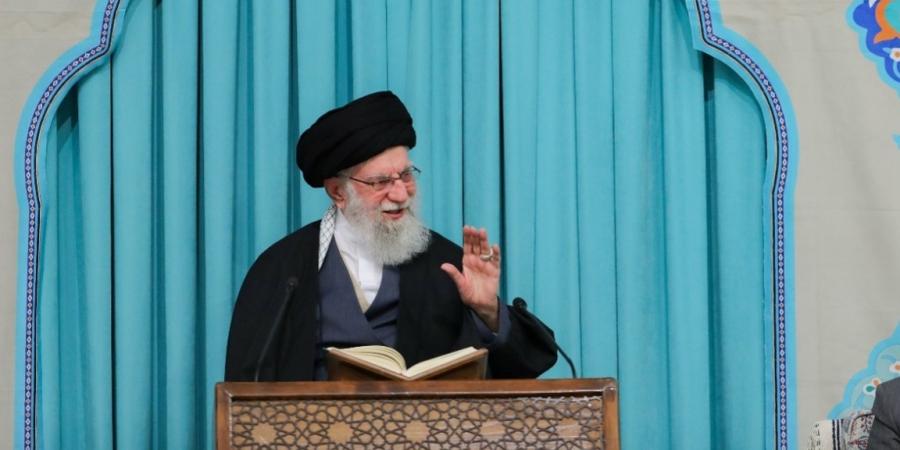
The first Friday Prayer Leader of Tehran
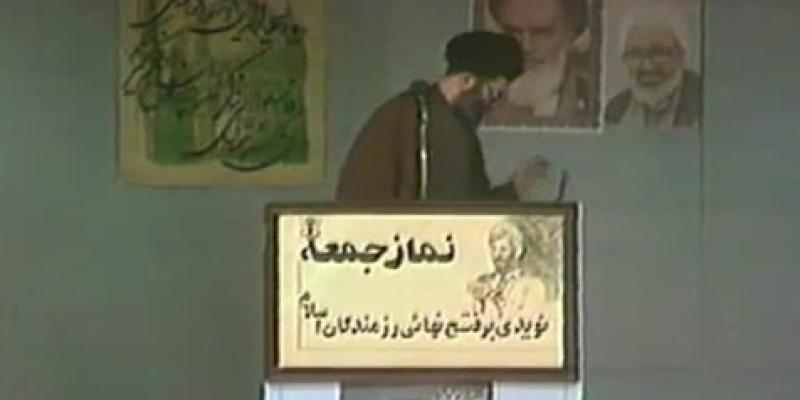
Photo: Friday, March 14, 1985. Ayatollah Khamenei is delivering the Friday prayer sermon in Tehran when a bomb detonated amidst a gathered crowd of worshippers. No high-quality photograph of this exact moment exists; this image is a still captured from the video footage of the incident.
Right from the place where the enemy sought to silence his voice, his message resounded even louder. During a Friday prayer in Tehran in 1985, Ayatollah Khamenei was delivering his sermon when the sound of an explosion suddenly ripped through the congregation. For a brief moment, the atmosphere grew heavy with tension, but even the blast could not break his resolve. The sermon was interrupted only momentarily before he continued his speech with the exact same calm and fortitude, as if to declare to all that the pulpit of truth cannot be silenced by terror and assassination.
This ability to touch people's hearts was evident in his character even before the victory of the Revolution – an influence rooted in his faith and sincerity. Following the Revolution, the Friday prayer pulpit became far more than just a place of worship for him; it transformed into a massive platform for conveying Islamic teachings, clarifying the ideals of the Revolution, and shedding light on the current affairs of both Iran and the Islamic world. It was from this very podium that he was able to broaden the intellectual horizons of an entire nation.
In January 1980, following his appointment by Imam Khomeini as the Friday Prayer Leader of Tehran, Ayatollah Khamenei led his first Friday prayer in the capital. This platform rapidly evolved into one of the most significant intellectual and political pillars of the Islamic Revolution. In the months that followed, alongside his active presence across various political and social arenas, he used this pulpit to articulate the core positions of the Revolution to the public. His engagements spanned from meeting diverse groups and fielding questions from university students to delivering speeches at major conferences and large public assemblies.
During those formative years, Friday prayers were far more than a weekly ritual; they served as a vital forum for keeping the Revolutionary spirit alive. From this pulpit, Ayatollah Khamenei not only expounded on Islamic teachings but also kept the public informed about the conspiracies, threats, and complexities facing the young Revolution. This profound rapport with the people would later manifest on an even grander scale, enabling him to navigate a nation through major crises and turbulent storms with his wisdom, foresight, and the deep trust of the people.
And that was the secret to his impact: he didn't just deliver speeches; he won people’s hearts. It was this very ability to connect with people that later defined his leadership, drawing millions to his side and keeping the path forward clear for an entire nation through the toughest of times with calm and steady resolve.
This image dates back to March 14, 1985, when a terrorist bombing during the Tehran Friday prayers martyred 13 worshippers and wounded around 100 others. Yet, after only a brief pause, Ayatollah Khamenei resumed his sermon and declared: "We will counter any strike with an even harder blow."
Photo: One of the many Friday prayers led by Ayatollah Khamenei in the Iranian capital in the early post-Revolutionary period.
Jun. 29, 2026