
Analysis
I'm glad I didn't take up the Leader's time!
Naime Javidi, journalist
Ayatollah Sayyid Ali Khamenei, the Leader of Iran, appeared before the students gathered for the annual Arbaeen meeting. Taking the microphone in his hand, he spoke a few words in praise of the path of Resistance, from the Ashura of Imam Hussain to the present day, and then told the students: "I always pray for you."
What is so extraordinary about this sentence that the loud sobbing of the crowd seemed ready to shake the Zainabiyah Hall of the Leader's residence to its foundations? Hadn't the United States bombed both his workplace and his home, and martyred him together with his family? How, then, had he come back to life, filling the eyes of the students attending this year's Arbaeen gathering at the Leader's residence with tears of longing, while once again sending a shudder through America?
This is the Zainabiyah—a building adjacent to the Imam Khomeini Hussainiyah within the Leader's residence, which, before the bombing, had long served as the venue for his public meetings. Ordinary people, athletes, artists, entrepreneurs, officials, intellectuals, students, and even Iranian children had all met their late Leader there on numerous occasions.
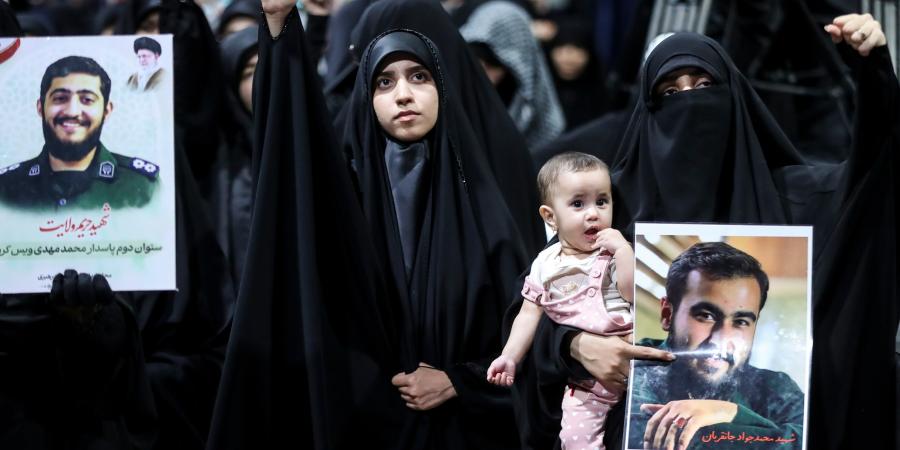
What follows is the story of the students' Arbaeen gathering at the Leader's residence, where the sight of the martyred Leader's images became a reason both for tears and for a renewed determination to avenge his blood.
O first pilgrim of Arbaeen! May your pilgrimage be accepted!
On 28 February, 2026, just one day before students were due to attend a meeting and iftar gathering with Grand Ayatollah Sayyid Ali Hosseini Khamenei, the United States bombed the Iranian Leader's residence and workplace.
Several months have passed since that event, yet the people neither wish nor are able to let go of the one they loved. On the occasion of various gatherings, they continue to assemble in the Zainabiyah building. They watch recordings of the martyred Leader's speeches and keep his memory alive, just as they did at this year's Arbaeen gathering of Iranian students and international students studying in Iran.
As several minutes of footage from last year's Arbaeen meeting were shown, tears gradually gave way to anger. Chants demanding vengeance filled every corner of the Zainabiyah.
The eulogists recited and sang of the Leader who, after years of longing to visit Karbala, finally became Iraq's first pilgrim of Arbaeen. Carried upon the hands and shoulders of the Iraqi people during his funeral procession, he visited the holy shrines not merely as the Leader of Iran, but as the martyred deputy of the Awaited Imam.
That magnificent funeral procession became the embodiment of a single phrase:
"Martyr Khamenei is stronger than Sayyid Ali Khamenei."
Ladies and gentlemen, stay young
Twenty-six-year-old Kowsar Halawi, originally from Lebanon, was born in Isfahan. After many years, she returned to Iran to continue her education, and today she is among the guests attending the students' Arbaeen gathering at the Leader's residence.
Having successfully completed her studies in dentistry, she now intends to return to Lebanon.
Halawi says:
"In a world where they claim that the West, and countries like France, is supposedly the cradle of civilization, young women wearing the hijab are not even allowed to keep their headscarves in academic institutions. I chose Iran for my studies because it has a high academic standing, and because it genuinely respects women, their dress, and their dignity."
Kowsar attended one of Ayatollah Khamenei's public meetings only a few months before his martyrdom. Recalling that meeting, she says:
"I had the honor of meeting a great Leader whose advice was always: 'Stay young.'"
It is an intriguing expression, and she explains what he meant:
"He would say that you must keep your spirit young so that you always possess the readiness, strength, and motivation needed for resistance and progress. He practiced what he preached. Every time I listen to his words, my own spirit is renewed. In a world where everyone is searching to become younger and more beautiful, he made hearts young and alive through his words."
I felt lost on the day it happened
The Lebanese dentistry student recalls the day she heard the news of the Leader's martyrdom:
"I felt as though we had become lost in the middle of this cruel, savage world. I was terrified. I didn't know what to do. But even then, he came to my aid. One of his speeches gave me peace of mind and strengthened my resolve to continue on this path until the Reappearance."
Halawi hopes to share with young students around the world the treasure she believes she has found in life.
"I hope every young person will have the determination and the opportunity to give themselves a great gift in life: to listen to the speeches of Sayyid Ali Khamenei. He did not speak only to religious people or only to the people of Iran. I can say with complete confidence that your life will be divided into two distinct chapters—before hearing his words and after hearing them."
She does not like it when people ask why she loves Iran's martyred Leader.
"Ayatollah Khamenei did not belong only to the people of Iran; he was our father. I have several videos in which he offers prayers at the end of his speeches. Whenever I miss him, I watch them over and over again, and my heart finds peace."
His face was purely celestial
Fatemeh Daqiq stands in one of the streets leading to the Leader's residence alongside her Lebanese friends, Iranian students, and people dressed in burial shrouds to demonstrate their readiness to avenge the martyred Leader of Iran. Their white shrouds declare that they harbor no fear when it comes to taking revenge upon the enemy and defending their Leader as they prepare to enter the ceremony.
This annual gathering feels remarkably different this year. American missiles have separated the people from the one they loved, yet no one recognizes that separation as real. Since when does true love have an expiration date or fade from a pure heart? It is this profound love and longing that has brought everyone together once again.
Among them is Fatemeh Daqiq, who speaks Arabic and broken Persian. She says:
"Before His Eminence's martyrdom, I saw him during one of the public meetings. I couldn't take my eyes off him. I simply kept looking at him. You would have done the same, because his face possessed a truly heavenly radiance. I was blessed with the opportunity—even if only once—to behold a reflection of the divine, the Deputy of the Imam of the Age (may Allah hasten his reappearance)."
She continues:
"Now that I have heard this student gathering is being hosted by the new Leader, Ayatollah Sayyid Mojtaba Khamenei, and organized through the enthusiasm of the students themselves, I sincerely pray that his blessed presence will always remain over all of us and over the forces of the Islamic Resistance throughout the world."
As someone from southern Lebanon—a land currently under relentless Zionist missile attacks—she has a request for the Iranian authorities:
"We hope the Iranian government will continue its brotherly support for Lebanon until our land is liberated from Israeli attacks. We are companions of one another in the Islamic Resistance."
I'm glad I didn't take up his time
A beautiful name always stands out wherever it is found, especially when it reflects the character of the person who bears it.
Rokhabeh Ghaffari, who holds a master's degree in Geriatric Health, is one such person.
The eulogies have not yet begun, nor has the speech. Yet she is already gazing at the photographs of the Leader displayed alongside those of the martyrs on the walls of the Zainabiyah, quietly weeping.
Her face is washed by an endless stream of tears.
I ask her what her name means.
"It means a face as pure as water."
I find myself speaking with a young woman who says:
"I am the daughter of a martyr. Throughout my life, there was only one person who could ease the pain of growing up without my father. We had a Leader who loved all of us—not just like a father, but better than a father. He even called those young people who had gone astray during the riots but later repented 'my children.' I never imagined the world could become so shameless that it would assassinate the leader of a country in broad daylight while still claiming to stand for international peace."
Ghaffari says she has often had to suppress her own wishes.
"My greatest dream was to see the Leader in person at least once. There was a time when he was supposed to officiate my marriage ceremony with my husband. I was overjoyed, but for one reason or another it was canceled."
She pauses before continuing:
"To be honest, at first I was surprised and disappointed. But then I changed my mind. I didn't want to take even a single minute of his precious time for my own sake. Wasn't it a pity for a Leader whose every sentence could overturn the enemy's calculations for months to have even a minute of his time spent on my personal affair?"
He never abandoned Palestine
Among the women attending the Arbaeen gathering beside the resting place of the martyred Leader—most of them dressed in black mourning clothes, wearing long manteaus, abayas, or chadors—Sara Mehdi stands out slightly.
She wears a black cotton scarf and a long, straight black dress in the style of Eastern women. With her wheat-colored complexion, pleasant features, and dark Eastern eyes, she immediately catches one's attention.
She is originally from India but now lives in London.
She understands Persian but cannot speak it, so our conversation has to be conducted in English.
She is kind and intelligent. How can one tell? To keep the conversation flowing—and, as she puts it, to make up for her inability to speak Persian—she deliberately chooses simple, familiar words to express herself.
Sara recalls her first meeting with the martyred Leader of the Revolution:
"I first saw him when I was a child, during a meeting I attended with my family. Unfortunately, I never had another opportunity until I came to Iran for his funeral. It was the largest funeral procession I have ever witnessed with my own eyes. His martyrdom left me with a deep sorrow and pain in my heart that still truly saddens me."
Born in Mumbai and now a student in London, she has retained the warmth and sincerity often associated with Asian hospitality. She answers each question honestly, warmly, and briefly.
When asked when she first realized she loved Iran's martyred Leader, she replies:
"When I saw that after Imam Khomeini, the only person who regarded the cause of Palestine with the same genuine importance was Mr. Khamenei. No threat and no personal interest ever made him abandon the oppressed people of Palestine."
His Blood Is Awakening Young People in the West
We ask Sara Mehdi, "We Iranians believe that our Leader's blood has awakened many people and led them to rethink their beliefs. Is this visible in the West—in England, where you live—as well?"
She replies:
"Do not underestimate the Western media's propaganda. Through an endless bombardment of information, they constantly ensure that truth is lost in an ocean of lies. Even so, I can tell you this: I see many young people—especially university students—for whom this event raised a profound question. Many of them did not even know who Mr. Khamenei was before all this happened. Now, however, they search for his speeches and listen to them. His blood has been a blessing. We are witnessing these very people becoming eager to study Islam, Shiism, and the Quran."
The visitor from India continues:
"Do you know which of Sayyid Ali Khamenei's statements I find most extraordinary? It is the one that says, 'Someone like me does not pledge allegiance to someone like Yazid.' That single sentence has illuminated the path of many people in distinguishing right from wrong."
The Indian ambassador for the children of Minab
If you ask us who made this conversation with the Indian student possible, we have only one answer:
The children of Minab.
Pinned to her long black scarf and cotton dress is a conspicuous pink circular badge. It bears the symbolic image of the school backpack of the students of Minab, together with the number #168—the number of schoolchildren martyred at the Shajarat Tayyibah School in Minab.
The school, located in southern Iran near the Strait of Hormuz, was struck in three successive waves of American Tomahawk missile attacks during school hours, while classes were in session.
When we point to the pink backpack badge on her scarf, her eyes fill with tears.
"This is nothing less than a major international crime—a war crime."
We ask whether, after the bombing of the Leader's residence and the killing of the children of Minab, it is fair to say that the world has become a lawless jungle.
She answers:
"With the presence of America and Israel, it is far more savage and lawless than any jungle."
Wearing that same circular badge wherever she goes, she has become an informal cultural ambassador, raising awareness among young people in the West about the suffering of the children of Minab.
As for me, I design modest clothing
According to Mousavizadeh, she spends less time painting these days and has devoted herself to another form of art: tailoring and fashion design, specifically modest Islamic clothing.
"My dream is to create clothing that gives the person wearing it such a sense of peace and well-being that it opens their mind to the idea that hijab is not incompatible with freedom. Every stitch I sew into the fabric is made with that hope."
We ask whether she has heard about the martyred Leader's letter to Western students and young people who defended Palestine.
She says she has not.
We summarize it for her:
"In essence, the Leader addressed those young people with one golden phrase: 'You are now standing on the right side of history.'"
The young Iranian student reflects:
"When someone hears that sentence, it naturally makes them ask themselves: Which side of history am I standing on—the right side or the wrong side?"
The cry of the oppressed is more powerful than the Butterfly Effect
Mousavizadeh tells me:
"In today's world of 'I'd rather not know,' some people believe that the most convenient approach is simply not to see or hear the suffering of others."
She smiles bitterly, as though she herself has experienced such days.
"Mr. Khamenei taught me never to close my eyes to anyone's suffering. Not because, if I remain silent and indifferent, the same fate might one day befall me. No. Our Leader taught us how to see correctly. I learned from him never to be indifferent because the one who suffers is not someone else—it is myself. All human beings are one."
The thoughtful young woman sitting across from us begins speaking about butterflies in the middle of the Zainabiyah Hall.
"When so many experts tell us that a storm in one part of the world may have been triggered by the fluttering of butterflies' wings somewhere else, they are trying to teach us that even the smallest movement matters in the science of management. If we can believe that, then why shouldn't we believe that the cries of the children of Minab, the martyred Leader's grandchild, and the children of Palestine will one day seize the Zionists by the collar? God Himself will bring about His plan, but we too must fulfill our duty. This blood must not be allowed to go unanswered."
He did not flee, he did not fear, and he was martyred
Zahra Naderi, a university student born in the 2000s, studies chemical physics.
Quietly, away from attention, she sits with the Quran.
When asked how many times she has visited the Leader's residence, she replies:
"When I was a child, and through my early teenage years, I used to come here with my family, especially during Muharram and the Fatimiyyah commemorations, for the gatherings hosted by the Leader. Today, although he is no longer physically with us, I honestly feel that it is his great spirit that has brought us together once again."
She gives three reasons for the love she carries in her heart for the martyred Leader.
"If I were speaking to university students around the world and wanted to convince them that this love is genuine and deeply rooted, I would tell them that we loved a man to whom we constantly said, 'May we be sacrificed for you,' yet in the end he sacrificed himself for us. He was a Leader who, even after receiving threats, did not flee. He remained in his home and at his workplace, where he was martyred together with his family. Is there any greater meaning to love of one's country and one's people? I don't think there is."
Our Leader was someone you could feel safe with
The second reason she gives, she believes, is something no young person in today's world could have failed to hear about.
"Even if people's own negligence—or the noise of the media—has caused them to hear less about the killing of children and the genocide in Palestine, they have certainly heard about the filthy and scandalous Epstein Island case. We had a Leader whose photographs, surrounded by young girls after their religious coming-of-age ceremony, demonstrated how deeply he loved children and what a pure and trustworthy Leader he was."
She continues:
"The third reason is that, in today's turbulent world, while the West constantly frightens people with the threats of death, disease, famine, and war, his words brought peace and reassurance about the future."
We ask: "So while everyone else was selling fear in order to harvest submission, he offered hope and tranquility?"
Naderi's eyes fill with tears.
"Exactly. Exactly. To everyone who still has doubts, I say this: all your life you have followed other paths and other people based solely on the judgment of your mind and intellect. Just once—even for a short time—give your heart a chance. Listen to this Leader's words, and let his own words introduce him to you. No one is asking you for blind obedience."
The book "Cell No. 14 "
We ask the young university student why she had been reciting the Quran so beautifully and with such composure. She replies:
"I journeyed from fear to the tranquility of the Quran. For a brief period in my life, I believed in nothing. I understand very well what it is like for a young European whose life has been deprived of spirituality. It is a complete limbo. One book reconnected me with the man I had admired since my childhood and adolescence—the Leader. "Cell No. 14 " is the Leader's memoir, told in his own words, from his childhood and youth until the time he became Leader. The book was originally written by Mr. Khamenei himself in Arabic for the fighters of the Islamic Resistance in Lebanon and was later translated into Persian. When I read it, I realized something: I am not meant to live only one life. I have two lives ahead of me—this earthly life and the eternal life to come. With that perspective, I understood why this man endured years of torture, struggle, imprisonment, and separation from his wife and children."
She says she has tried to bring everything she learned from the book into her own life:
"The materialistic outlook on life in the West—a worldview that social media has been remarkably successful in promoting—constantly leaves people with the feeling that they are missing out. It tells you that if you don't eat this, wear that, travel, or entertain yourself, then your life is somehow wasted. It leaves people hopeless and depressed. Before long, you realize you have gradually become someone willing to do almost anything just to make yourself happy in the moment. And if you can't, you either become depressed or, perhaps, rebellious."
Aug. 6, 2026