
What is Arbaeen?
A historical narrative
After the martyrdom of the Prophet of Islam, Prophet Muhammad (pbuh), a dispute arose among Muslims regarding the issue of his succession. According to the belief of Shia Muslims and the testimony of history, the Prophet of Islam resolved this matter during his final Hajj pilgrimage, entrusting the affairs of guidance and governance after himself to Ali ibn Abi Talib (pbuh) and the Infallible Imams from his progeny:
"The issue of leading the Islamic society; the issue of the system of governance and Imamate in the Islamic society. Yes, deviations may occur—as they indeed did; for several centuries, the Umayyads, the Abbasids, and their likes ruled as kings; they reigned as monarchs—in the name of Imamate, Caliphate, and the like. However, this does not inflict any damage upon the philosophy of Ghadir. The event of Ghadir’s determination is the event of establishing a criterion, of defining a rule. A rule was established in Islam; the Noble Prophet established this rule during the final months of his life. What is that rule? It is the rule of Imamate; the rule of wilayah... The rule of governance, authority, and power dynamics in the Islamic society was specified and laid down through Ghadir; this is the significance of Ghadir. The significance of Ghadir is not merely that the Commander of the Faithful [Imam Ali (pbuh)] was appointed; this too is important, but more important than this is that they specified the criterion, they set the rule. It became clear that in an Islamic society, monarchical rule is meaningless, personal governance is meaningless, governance by wealth and force holds no meaning, aristocratic governance holds no meaning, governance based on arrogance toward the people holds no meaning, governance characterized by privilege-seeking, greed, hoarding and accumulating for oneself holds no meaning, and governance driven by lustful indulgence is meaningless; it became evident that in Islam, that’s how things are." (September 20, 2016)
The dispute over this matter exposed the future of the Islamic world to grave dangers. A few days after this event, the daughter of the Prophet, Lady Fatimah Zahra (pbuh), addressed a gathering of women of Medina, stating:
"By God, this action of yours has conceived sedition and corruption; wait a little until it yields its result. From this bowl of milk, you shall milk blood; that is when later generations will understand what the predecessors have done. Be prepared for seditions. Be announced the tidings of drawn swords, a chaotic disorder encompassing all, and a despotism by tyrants that will seize from you whatever you possess."
History proved the accuracy of the words of the Prophet's daughter, who was martyred as a result of these very conflicts. Less than 20 years after these events, class divide and ideological corruption in the Islamic world reached a point where people set out from Iraq and Egypt toward Medina, the center of the Caliphate, to kill the Caliph. After besieging the Caliph's residence, they killed him and pledged allegiance to the new Caliph, Ali ibn Abi Talib (pbuh). This interval of roughly 25 years brought major changes to the Islamic society. One of the most significant among them was the emergence of the Umayyad dynasty—the primary enemies of Islam during its earliest days—as one of the poles of power. The efforts of the Umayyads, particularly Muawiyah ibn Abi Sufyan, aimed at altering the religion of Islam and transforming it into an instrument for the pursuit of power, led to severe conflicts within the Islamic world after governance returned to the household of the Prophet [Ahl al-Bayt] and the Commander of the Faithful, Imam Ali (pbuh).
Muawiyah, who was the ruler of Levant [Sham], refused to submit to the Caliphate of the Commander of the Faithful and waged war against him. The Battle of Siffin—fought between the army of the Commander of the Faithful, which comprised a large number of the Prophet's companions, veteran Muslims, and the people of Iraq, and the people of Levant, most of whom were recent Muslim reverts who had learned Islam primarily from individuals like Muawiyah—was one of the bloodiest wars in early Islam. It was a war that produced no victor, and approximately three years thereafter, the Commander of the Faithful was martyred in an assassination. Following this, Muawiyah entered into conflict with the grandson of the Prophet of Islam and son of Imam Ali, Imam Hassan al-Mujtaba (pbuh), who had been chosen by the people as the Caliph.
Although this confrontation did not lead to a major war, a campaign of propaganda, assassination, and treachery within the army of Imam Hassan al-Mujtaba (pbuh) ultimately compelled the Imam to sign a permanent ceasefire agreement with Muawiyah and step down from the Caliphate under specific conditions, so as to preserve the security of the believers and create an opportunity to propagate true Islam.
"During the era of Imam Hassan (pbuh), an opposition movement grew to such an extent that it was able to manifest as an obstacle. Of course, this opposing movement did not come into existence during the time of Imam al-Mujtaba (pbuh); it had emerged years earlier. If one were to speak somewhat detached from theological considerations and rely solely on historical evidence, one might even claim that this current did not originate during the Islamic era; rather, it was a continuation of what existed during the period of the Prophet’s mission—that is, the Meccan period. After the Caliphate fell into the hands of this group during the reign of Uthman—who was from the Umayyads—Abu Sufyan, who was blind at that time, was sitting together with his friends. He asked: 'Who is present in this meeting?' He was told that so-and-so, so-and-so, and so-and-so were present. When he was assured that everyone was of their own circle and that no outsider was in the gathering, he addressed them and said: ‘Talaqqafunnahā talaqqufa al-kurah’—meaning: Pass governance among yourselves like a ball, and do not let it slip out of your hands!" This issue has been narrated by both Sunni and Shia historical sources. These are not matters of belief, and we are absolutely not discussing this from a doctrinal standpoint; that is to say, I prefer not to examine these matters from that perspective, but rather I am presenting solely its historical aspect. Of course, Abu Sufyan was a Muslim at the time and had embraced Islam; however, it was an Islam after the conquest [of Mecca] or on the verge of conquest. It was not an Islam of the era of isolation and vulnerability; it was an Islam after Islam had attained power. This movement reached the peak of its power during the time of Imam Hassan al-Mujtaba (pbuh), and it was the very same movement that manifested in the form of Muawiyah ibn Abi Sufyan against Imam Hassan al-Mujtaba (pbuh). This movement initiated the opposition. It blocked and severed the path for Islamic governance—that is, Islam in the form of a system of governance—and created difficulties to the extent that it practically prevented the progress of that Islamic governance movement... Following the peace treaty of Imam Hassan al-Mujtaba (pbuh), matters were arranged in a clever and shrewd manner so that Islam and the Islamic movement would not enter the polluted channel that had come into existence under the name of the Caliphate—which, in essence, was a monarchy. This was the masterstroke of Imam Hassan al-Mujtaba (pbuh). Imam Hassan al-Mujtaba (pbuh) acted in such a manner that the authentic Islamic movement—which had originated in Mecca, culminated in an Islamic government, and carried through to the era of the Commander of the Faithful and his own time—would flow through a different channel. Even if it could no longer operate in the form of a government—for that was no longer possible—it would at least continue once more in the form of a movement... Had Imam Hassan (pbuh) not concluded a peace treaty, they would have eradicated all the pillars of the Prophet’s (pbuh) household, leaving no one behind to safeguard the authentic value system of Islam. Everything would have been completely obliterated, the very mention of Islam would have been effaced, and the historic event of Ashura would never have come to pass." (April 11, 1990)
In the final years of Muawiyah's life, he made a consequential decision regarding his succession. Although the Prophet of Islam's decision for his succession was for this office to pass to the Commander of the Faithful and the infallible Imams, after the martyrdom of the Prophet (pbuh), the Muslims effectively altered this arrangement, entrusting the selection of the Caliph to the allegiance of the "Ahl al-Hall wa-l-'Aqd" (those who bind and unbind). This meant that a body of individuals possessing knowledge and early precedence in Islam—comprising mostly companions [Sahabah] and successors [Tabi'un] of the Prophet—would select whoever they thought possessed the competence for the Caliphate and pledge allegiance to him. This mechanism carried within itself significant deviations from true Islam, and Fatimah Zahra (pbuh) was martyred in opposition to this very "heretical innovation" [bid'ah].
Yet, Muawiyah had resolved to alter even this custom. Through the use of intimidation, he sought to secure allegiance for his son, Yazid, from prominent religious figures and tribal elders, thereby effectively transforming the institution of the Caliphate in Islamic society into a hereditary monarchy.
Prominent figures across the Islamic world rose in opposition to this decision—figures who had perhaps previously fought on opposing sides in past conflicts, such as Imam Hassan al-Mujtaba (pbuh) and Imam Hussain (pbuh), Abdullah ibn al-Zubayr, Abdullah ibn Umar, and Abd al-Rahman ibn Abi Bakr, among others.
As long as Muawiyah was alive, opponents of Yazid's succession were eliminated through various means, including bribery, inducement, and assassination. Imam Hassan al-Mujtaba (pbuh) was also assassinated, leaving his brother, Hussain ibn Ali (pbuh), as the most prominent opponent of Yazid's monarchy.
With the death of Muawiyah, efforts to secure the official recognition of Yazid's rule entered a new phase, and those who refused to pledge allegiance to him were openly threatened with death. It was under the shadow of this threat that Imam Hussain (pbuh) departed from Medina and set out toward Mecca. In the Islamic world, Mecca was a city where bloodshed and warfare were forbidden, granting political dissidents a measure of sanctuary.
On his journey out of Medina and during his stay in Mecca, Imam Hussain (pbuh) engaged in discussions with numerous religious scholars as well as key tribal and political figures. Highlighting the grave dangers of this new precedent, he articulated the reason for his departure as follows:
"I have not risen out of ingratitude, excess-seeking, or for the sake of corruption and tyranny; rather, I seek the reformation of my grandfather’s Ummah. I wish to enjoin good and forbid evil, and to conduct myself according to the tradition of my grandfather and my father, Ali ibn Abi Talib (pbuh)."
From the time the Commander of the Faithful, Imam Ali (pbuh), assumed the Caliphate, Kufa and Iraq were regarded as the most prominent center of supporters for the governance of the Ahl al-Bayt (pbut). They, too, refused to pledge allegiance to Yazid and endeavored to stand firmly against his government. For this reason, they dispatched letters of invitation to Imam Husayn (pbuh), requesting that he assume their leadership and Imamate so that they might rise up against the government of Yazid.
Imam Hussain (pbuh) sent a representative to Kufa, who confirmed the readiness of the people of Kufa for the uprising. Immediately following the Hajj pilgrimage, the Imam departed from Mecca and set out toward Iraq. However, the people of Kufa were subdued by the machinations and threats of the city’s governor, who was appointed by Yazid, and they were unable to seize control of the city. The government army, aware of Imam Hussain's (pbuh) route, marched out of the city and, in the land of Karbala, they encircled the caravan of Imam Hussain (pbuh), which comprised his companions and family members.
Ultimately, after approximately a week, on the tenth day of Muharram in the year 61 AH, a day known as Ashura, a 30,000-strong army waged battle against Imam Hussain (pbuh) and his his fewer than 100 companions, martyring him in an oppressive and savage manner. In the days leading up to the battle, this army of several tens of thousands also cut off the water supply to Imam Hussain's (pbuh) caravan, thereby perpetrating a horrific tragedy in the history of Islam.
Following the battle, Yazid's army took captive the women and children of Imam Hussain’s caravan, who were the family of the Prophet (pbuh). Imam Hussain’s second son, Imam Ali al-Sajjad (pbuh), who was unable to fight due to severe illness, was also taken captive. This caravan first traveled from Karbala to Kufa, then proceeded from Kufa to Damascus. According to some historians, 40 days after the event of Ashura, on their return journey to Medina, they returned to Karbala and engaged in mourning alongside a group of devotees of the Ahl al-Bayt who had journeyed there. During these historical 40 days, the caravan of captives proclaimed the message of Imam Hussain’s uprising and the realities of the Day of Ashura at the top of their voices along the entire route.
"In the tragedy of Karbala, Arbaeen marked a commencement; it was a new beginning... The nature of an environment of suppression is such that people do not find the opportunity or the courage to reflect in their actions the truths they have come to realize... Many came to understand many things through the words of Zainab al-Kubra (pbuh) or Imam al-Sajjad (pbuh), or by witnessing the condition of the captives; but who had the courage, who possessed the ability to express what they had understood in the face of that apparatus of tyranny, arrogance, despotism, and suppression? It remained like a pent-up anguish in the throats of the believers. This pent-up anguish was first lanced open on the day of Arbaeen; the the initial surge broke forth in Karbala on the day of Arbaeen." (February 16, 2009)
This historic movement once and for all demarcated the line of authentic Islam from the deviant, monarchical Islam pursued by the Umayyads and, later, the Abbasids, and it taught the world the meaning of the noble hadith of the Prophet (pbuh), who said: "I am from Hussain, and Hussain is from me." Imam Hussain (pbuh) was not only the grandson of the Prophet, but through his uprising, he also became the guarantor of the survival of the Prophet’s religion.
"These 40 days that transpired between Ashura and Arbaeen constitute one of the most critical junctures in Islamic history. While the Day of Ashura stands at the pinnacle of importance, these 40 days spanning Ashura and Arbaeen are second only to Ashura itself. If the Day of Ashura marks the apex of struggle combined with self-sacrifice, these 40 days represent the apex of struggle paired with clarification, exposure, and elucidation... It was this monumental movement and the extraordinary patience exhibited by the Prophet’s Household – led by Lady Zainab Kubra (pbuh) and Imam Sajjad (pbuh) – that succeeded in eternalizing the event of Karbala; in the truest sense of the word, this clarification served as the necessary complement to that sacrifice." (September 27, 2021)
Muharram, Safar, and Arbaeen
In Shia Islam, the first two months of the lunar calendar—Muharram and Safar—hold a distinct significance. These two months symbolize the unending struggle of authentic Islam against any attempt to distort or alter the religion. The deviation that originated at Ghadir reached its peak on the tenth day of Muharram in the year 61 AH, when the Prophet's Household was slain and taken captive. From that very day, the Ahl al-Bayt, led by Imam Sajjad (pbuh), carried forward the Islamic movement, and mourning during the months of Muharram and Safar became the most prominent symbol of this movement. Traditions record that devotees of the Ahl al-Bayt would recount the events of that day on the anniversary of Ashura: "They wore black garments of mourning and paid no heed to the cold or heat [during their lamentations], while Ali ibn al-Hussain (pbuh) prepared food for them so they could engage in mourning."
The Islamic movement of the Imams and the mourning gatherings for Imam Hussain (pbuh) gradually expanded. Roughly two centuries elapsed between the martyrdom of Imam Hussain (pbuh) and the era of Imam Hassan al-Askari (pbuh)—the final period in which Shia Muslims were in direct contact with their Imam. Over these two centuries, Shia communities lived under the crushing oppression of the Umayyad and Abbasid regimes, forming clandestine economic, cultural, religious, and political networks through which they spread authentic Islam. Throughout these two hundred years, one of the primary Shia rites and customs was the holding of mourning gatherings during Muharram and Safar, which gradually culminated on the day of Arbaeen—that is, forty days after Ashura.
Martyr Ayatollah Sayyid Ali Khamenei described the emergence of the Arbaeen phenomenon as follows:
"The Shia were a dispersed community... yet like the beads of a rosary, a single thread connected them all together. What was that thread? It was the thread of obedience to the central authority of Shia Islam, to the supreme leadership of Shia Islam—that is, the Imam... Two individuals might have known nothing of each other’s circumstances, yet there were those who kept track of everyone... There was just one problem: they rarely saw each another. The inhabitants of a single city and the Shia of a particular region would, of course, see one another, but a global congress was necessary for the Shias during the era of the Imams (pbuh). They designated this global congress, and they also specified its time as well; they declared that whoever was able should participate in that congress at this appointed time. That appointed time is the day of Arbaeen, and the place of gathering is the land of Karbala—because the spirit of the Shia is a Karbala-infused spirit; it is an Ashura-infused spirit."
21st-century Arbaeen
More than 1200 years have passed since those initial Arbaeen pilgrimages. The Shia—once a clandestine network confined to Kufa, Medina, and Rey—have now expanded across the entire globe. From the foothills of the Himalayas in India and Pakistan to the capital of Thailand, from Russia and Turkey to Nigeria and Kenya, and throughout West Asia, Shia Islam today stands as one of the most significant Islamic schools of thought and one of the world's most influential religious communities.
Over the centuries, various Shia governments arose in different parts of the world, each writing its own pages upon the history of Muharram and Arbaeen mourning commemorations. Governments that opposed the Shias throughout this millennium likewise contended with the Shia movement, each attempting in its own measure to suppress these commemorations. Yet in the opening years of the 21st century, Arbaeen took on a new meaning and manifestation.
With the victory of the Islamic Revolution in Iran and the Ba'ath regime's fear of the revolution spreading to Iraq, the regime under Saddam Hussein restricted Muharram mourning rites and the Arbaeen pilgrimage toward Karbala to an unprecedented degree. Ultimately, with the fall of Saddam Hussein, the grounds were prepared for the resurgence of Arbaeen.
The early years following Saddam’s downfall were marked by widespread insecurity in Iraq, with US occupying forces and Takfiri terrorists each creating their own obstacles for pilgrims. After ISIS [Daesh] invaded Iraq and Shia leaders issued fatwas for jihad, the Shias of Iraq—with the assistance of the Islamic Republic of Iran—took responsibility for securing the country, particularly the holy pilgrimage cities and the Arbaeen route.
The final years of the fight against ISIS coincided with the globalization of Arbaeen and the intensification of the "Hussaini Magnetism":
"The onset of the attraction of Hussaini magnetism begins on the day of Arbaeen. It is what lifts Jabir ibn Abdillah from Medina and draws him to Karbala. This is the very same magnetism that today, even after the passage of many centuries, resides in your heart and mine. For those who possess true recognition of the Ahl al-Bayt, love and passion for Karbala remain ever alive in their hearts. This began on that very day." (March 21, 2006)
In Arbaeen 2025, approximately 22 million people from all over the globe undertook the pilgrimage to visit the shrine of Imam Hussain (pbuh).
The Arbaeen Walk: From symbolism to mysticism
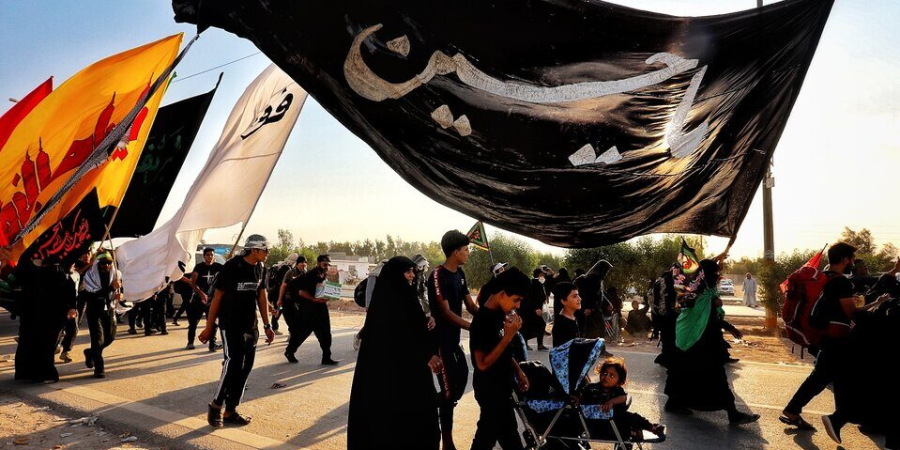
The Arbaeen Walk is held every year from various cities across Iraq toward Karbala. Its most renowned route is the 80-km road connecting Najaf to Karbala. This pilgrimage symbolically recreates the return of Imam Hussain's family to Karbala following Ashura.
The roadsides along the route are lined with Mawkibs. A Mawkib is a permanent or temporary structure used for sheltering and hosting pilgrims, cooking meals, providing medical services, and conducting cultural activities. Every year, following the exemplar of Imam Sajjad (pbuh), hundreds of thousands of people dedicate a portion or the entirety of their annual savings to serve the pilgrims of Imam Hussain (pbuh). Some transform their homes into Mawkibs, some distribute hundreds of thousands of meals, and others simply hand cups of water to the walking pilgrims. Each person contributes according to their means along this path, for they know that Imam Hussain (pbuh) sacrificed his entire being and his family so that the message of authentic Islam would reach us.
Imam Hussain’s lesson of self-sacrifice to the Arbaeen pilgrims and hosts has been that, in the pursuit of realizing an Islamic society, everyone must give whatever lies within their capacity—some give their time and footsteps; some their money and savings; some their comfort and security; and some their very blood and lives.
It is precisely this all-encompassing self-sacrifice that has made possible the presence of tens of millions of people in Iraq—a country that has not yet fully recovered from the lingering effects of years of war. One needs only to reach one of the routes of this walk: your food, drink, and place of rest are provided free of charge, and everyone steps forward to assist you in completing this journey.
Yet beyond its symbolic meanings, the pilgrimage on foot toward the shrine of Imam Hussain (pbuh) is also a mystical journey. Repetition is one of the core concepts in Islamic mysticism. With every step taken toward Karbala, with every glass of drink handed to a pilgrim, with every plate of food offered to them, and with every instance an individual gives away what they hold dear for the sake of God, the love for Imam Hussain (pbuh) and his path—which is none other than the authentic Islam of the Prophet Muhammad (pbuh)—takes deeper root in the human heart. It serves to internalize the logic of Islam within one's soul:
"Today, we need to make Hussain ibn Ali known to the world... Today, propaganda is deployed against Islam and Islamic teachings through hundreds of avenues; in the face of this hostile movement by the front of disbelief and arrogance, the movement of Hussaini knowledge can single-handedly stand firm, shield its chest, and present the reality of Islam and the truth of the Quran to the world. The logic of Hussain ibn Ali (pbuh) is the logic of defending the truth; it is the logic of standing firm against oppression, tyranny, misguidance, and arrogance. This is the logic of Imam Hussain, and today's world stands in need of it. Today, the world witnesses the reign of disbelief, arrogance, and corruption; it witnesses the reign of oppression. Imam Hussain’s message is a message of salvation for the world. The monumental movement of Arbaeen spreads this message throughout the world, and by divine grace, power, and success, this movement must be strengthened day by day." (September 18, 2019)
The magnificent Arbaeen pilgrimages of the 21st century bore their true fruit in the events following Operation Al-Aqsa Flood—where the lovers of Hussain ibn Ali (pbuh) and his Ashurai companions took up arms one after another in defense of the oppressed. They fought and gave their lives, yet refused to leave the call of the oppressed unanswered. Arbaeen and the people of Arbaeen became the mighty arm of the Islamic world:
"Today, the Islamic world is witnessing one of the manifestations of strength, and that is the Arbaeen Walk: 'And prepare against them whatever force you can.' The Arbaeen Walk is the strength of Islam, the strength of truth, and the strength of the Islamic Resistance Front, wherein such a monumental, million-strong gathering sets forth toward Karbala, toward Hussain, toward the pinnacle and zenith of the honor of sacrifice and martyrdom, from which all the free-spirited people of the world must draw inspiration." (October 13, 2019)
Yet Arbaeen is not confined to the Shia. The Arbaeen Walk is a march toward all the sublime values for the realization of which the Prophet of Islam (pbuh) was sent: the worship of the Creator of the universe, justice, material and spiritual perfection, generosity and self-sacrifice, courage, dignity, and true freedom...
Even though Arbaeen is not reflected in the global media today as it ought to be, it nonetheless attracts an ever-growing number of people from across the globe toward itself each year:
"Today, in the complex, propaganda-saturated, and tumultuous world that dominates humanity, this Arbaeen movement is a resounding cry and an unparalleled medium. Nothing of this sort exists anymore in the world: that millions of human beings set forth, not merely from a single city or a single country, but from diverse countries; and not merely from a single Islamic school of thought, but from various Islamic denominations and even certain non-Islamic religions. This is the unity of Hussain." (October 13, 2019)
"Arbaeen has become global, and it will become even more global. It is the blood of Hussain ibn Ali (pbuh) that has been surging for 1400 years, becoming fresher and more pulsating day by day. This is the very message of Ashura that issued forth from the throats of Imam Hussain (pbuh) and Zainab al-Kubra (pbuh) in the utmost state of exile and solitude; today, it has pervaded the world and will continue to encompass it. Hussain (pbuh) belongs to humanity. We as Shias take pride in being the followers of Imam Hussain, yet Imam Hussain does not belong exclusively to us; all Islamic schools of thought, both Shia and Sunni, stand beneath the banner of Imam Hussain. Even those who do not profess the faith of Islam participate in this monumental Walk, and this continuum shall endure, God willing. This is a grand sign that Almighty God is showing us. In an era wherein the enemies of Islam and the enemies of the Islamic Ummah are deploying every imaginable tool and means—money, politics, and weaponry—against the Islamic Ummah, the Almighty God suddenly grants such grandeur and splendor to the Arbaeen Walk. This is a supreme divine sign; it is the manifestation of the divine will to grant victory to the Islamic Ummah, signaling that Almighty God has willed the triumph of the Islamic nation." (September 18, 2019)
Aug. 4, 2026