Mohammad Raad, in an interview with Khamenei.ir:
Martyr Khamenei: A model of steadfastness, conviction, and leadership in confronting Global Arrogance
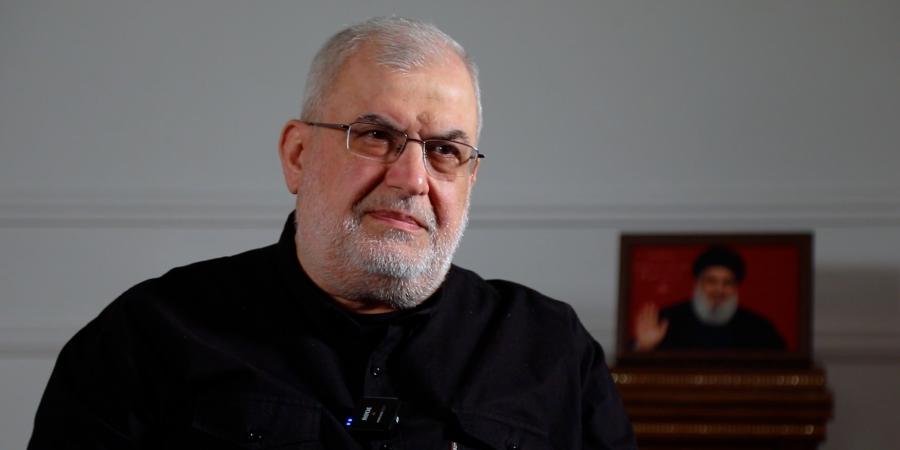
On the occasion of the farewell, funeral, and burial ceremonies for the pure bodies of the martyred mujahid Imam Sayyid Ali Khamenei and the members of his family, Khamenei.ir has conducted an interview with Mohammad Raad, head of Loyalty to the Resistance Bloc in the Lebanese parliament, about Martyr Khamenei and his leadership.
Question: Based on your knowledge of and experience with the martyred Leader of the Islamic Revolution, how would you describe his most important personal and leadership qualities?
M. Raad: The reality is that speaking about a great figure in the history of Islam and the Muslim world, particularly in their contemporary political history, such as the Leader, Grand Ayatollah Sayyid Ali Khamenei, is among the most difficult of tasks.
Whichever aspect of his personality one considers, one finds an outstanding quality that reflects his greatness: the certainty and steadfastness of his faith, the coherence of his thought, his kindness and compassion toward the oppressed, his unwavering commitment to enduring principles and values, his faithful guardianship of the testament of Imam Khomeini, the founder of the Islamic Republic, and the way he embodied honesty and trustworthiness in just and rightful governance by strengthening the foundations and institutions of the Islamic Republic and presenting an ideal model of government based on these principles.
All of these firm pillars of his character demonstrate that he was a unique personality in our contemporary history—and indeed throughout the political history of Islam over the centuries. He was courageous, a distinguished Islamic jurist, an able administrator and strategist, deeply aware of the circumstances of his age, familiar with the methods and approaches others employed in governing, and committed to the sovereignty of Islam, Islamic justice, and Islam's capacity to provide a political, administrative, and jihad-oriented model that safeguards humanity's rights and spreads justice throughout society.
Threats did not frighten him, nor did psychological warfare or intimidation have any effect on him. He remained steadfast, firmly convinced through certainty, faith, and unwavering belief that anyone who perseveres in defending what is rightfully theirs will ultimately defeat their enemy and secure great achievements for their people and nation.
Question: In your view, what role did the martyred Leader of the Islamic Revolution play in strengthening the Islamic Republic, supporting the Resistance Front, and confronting the United States and the Zionist regime?
M.Raad: The strength of this leader lay in his resilience, steadfastness, and ability to withstand every conspiracy and threat directed against the Islamic Republic from the very beginning of the Revolution in 1978–79 until today—a period spanning forty-seven years. Yet after every stage of confrontation, the Islamic Republic emerged stronger, more resilient, and more determined than before to continue pursuing its objectives.
What are the objectives of the Islamic Republic?
They are to establish truth, spread justice, organize the affairs of the Muslim nation in such a way that hostile powers cannot interfere in its society and affairs, and build an Islamic society committed to divine commandments—commandments that defend truth, confront falsehood and its adherents, and struggle against them. These are among the noblest and highest of all objectives.
Likewise, it seeks to challenge an international community that constantly speaks the language of human rights while never truly defending them. Instead, it allows the great powers to trample upon the rights of weaker peoples and promotes their conspiracies in order to distract the oppressed from those who seize their rights, plunder their nations' wealth, and dominate their governments.
The experience of the Leader, his steadfastness, and his persistent demonstration that even seemingly invincible enemies can in fact be defeated exposed the true nature of those enemies. The clearest evidence of this is what we witness today.
The confrontation between the Islamic Republic and the "Great Satan"—the United States—and its "rabid dog," the Zionist regime, revealed that the prestige of the United States was largely an illusion. America emerged from this conflict defeated. It failed to achieve its objectives, proved incapable of accurately assessing the situation, and relied on lawless and criminal forces to compel nations to submit to its policies. This was evident in Gaza, where it enabled genocide and supported the Zionist enemy in carrying it out, trampling upon human dignity and basic human rights.
By contrast, Iran emerged from the war proud, strong, and victorious. It succeeded in imposing its own will, objectives, and desired outcomes upon its American adversary. This became evident in the recent memorandum of understanding. Every time I examined its provisions, I did not find a single clause that fulfilled American demands. All fourteen clauses served the interests of the Islamic Republic. Of course, implementing those provisions is another matter, but the document's title and message were clear from the outset.
In any case, this serves as an example that steadfastness in truth and unwavering commitment to it ultimately lead to the desired results that one can hope to achieve by adhering to what is right.
Support for the oppressed, support for Muslims, and support for oppressed peoples were principles that never left the Leader's mind or thinking. Rather, they remained constant concerns that he transformed into practical programs aimed at assisting and supporting peoples and anti-imperialist movements.
Iran extended countless helping hands to support, assist, and aid these peoples so they could obtain their rights—from the most distant lands to the poorest and most deprived countries. The generous hand that the martyred Leader extended to these peoples and movements presented a clear and inspiring image of the Islamic Republic and its role in the world.
Question: Following the martyrdom of the Leader of the Revolution, what do you consider to be the most important intellectual and practical legacy he has left for the Islamic Ummah and the Resistance movement? What lessons have you learned from his example?
M.Raad: The loss and martyrdom of our Leader and Wali al-Faqih, Sayyid Ali Khamenei, may God sanctify his soul, is an irreparable loss for us.
He once said of the martyred Secretary-General, Sayyid Hassan Nasrallah, that he was an unparalleled personality. We, in turn, say that this unparalleled personality was nurtured in his school and became an extraordinary figure because he adhered to his method, loved him deeply, and was devoted to him.
He reached the point where he looked only to him for guidance, and whatever the Leader desired became a religious obligation for him—not only what he explicitly ordered, but even what he preferred and approved. Such was his devotion because this jurist and leader deserved to have soldiers willing to sacrifice everything in order to realize his vision and sound judgment.
When nations truly come to feel his absence, they will understand the immense loss they have suffered through his martyrdom.
He attained salvation and the rank of martyrdom, but we are the ones who have lost him. Nothing can compensate for this loss except remaining steadfast on his path and adhering to his method.
This is our counsel to all our brothers in Hezbollah as well as to the other resistance movements.
Gaza has lost him. The resistance in Gaza has lost him. Every resistance movement throughout the world that stands against the arrogant powers has lost him. Palestine and its cause have likewise lost him.
Had it not been for his presence and his unwavering insistence on supporting the Palestinian cause, that cause would have disappeared more than a quarter of a century ago. Yet he continually breathed new life into it, called people to jihad and steadfastness, and kept hope alive in the hearts of Palestinian fighters so that they would remain firm in confronting the Zionist occupation.
The Zionist enemy, in its confrontation with Iran, lost the image of superiority it had cultivated throughout the region because its inability to achieve its objectives against Iran became unmistakably clear. That alone is a source of pride for Iran.
We extend all our greetings and respect to Iran, to its Leader, the Wali al-Faqih, Ayatollah Sayyid Mojtaba—may God protect him and perpetuate his shadow—as well as to its officials, its political and military institutions, including the Revolutionary Guard, the Army, and the Basij, and to the great Iranian nation.
This is a people who have demonstrated their worth in the arena of life. They are the very people whose image had long been distorted among the nations of the world, but it has now become evident that they are among the greatest peoples on earth because they recognized the path of truth, learned how to defend their rights, understood that the homeland is humanity's most precious possession, and realized that defending it is the highest priority.
They set aside their differences and united around their leadership, their political system, and their struggle against their common enemy. The steadfastness of the great Iranian people is an instructive example for all of us. The Leader, Imam Khamenei, may God sanctify his soul, always strove to preserve the unity of the Iranian people.
I will never forget the image of him standing at the pulpit during Tehran's Friday Prayer in 2009, in the days of the unrest. His voice trembled with emotion as he addressed our Master, Imam al-Mahdi (may God hasten his reappearance), saying: "I am powerless. I have done everything within my ability. The Islamic Republic belongs to you; administer it as you see fit."
If those words signify anything, they testify to the firmness of his certainty and to the profound concern the martyred Leader had for preserving the unity of the Iranian people. They also reflect his conviction that all of Iran's officials and administrators must work together to realize the aspirations of the nation.
Competition has its proper place, but unity of purpose must always come first, because unity of purpose guarantees the unity of the country.
We learned countless lessons from him.
During those difficult days that we in Lebanon do not like to remember, when tensions arose between us and our brothers in the Amal Movement, I visited him.
He was deeply concerned and saddened. His foremost advice, which he repeated continually, was: "Preserve your unity. Never allow yourselves to fight one another and give your enemies cause to rejoice over your divisions." From that time onward, we devoted ourselves to unifying our ranks, harmonizing our positions, and bringing viewpoints closer together in order to preserve our unity against our enemies.
Today we are reaping the blessings of that advice. The Leader never knew despair. He constantly planted hope.
On one occasion, we believed an agreement was taking shape that would come at the cost of eliminating the Palestinian cause. America, Israel, and their allies appeared determined to contain the Arab forces and prevent them from supporting Palestine.
We met with him and expressed our concerns, which were filled with deep anxiety. When we finished speaking, he smiled at each one of us. Heading our delegation was the esteemed martyr Sayyid Hassan Nasrallah. The Leader said: "There is no reason for concern. We perform our duty, and it is God who directs affairs." He then quoted a saying of the Prophet Muhammad that has remained in my memory ever since, around the year 2002: "Be more hopeful for what you do not expect than for what you do expect. Moses went out seeking fire for his family, but he returned as a prophet." It is God who directs affairs. It is God who determines the roles people play. This path remains under His care.
We see only outward appearances and present realities, but there is also an unseen world that we must never neglect, nor should we ever harbor ill thoughts about Almighty God. Our duty is simply to fulfill our obligation. And indeed, that is exactly what happened.
Within a matter of weeks and months, all the efforts that had advanced to the brink of extinguishing the Palestinian cause through various so-called peace plans and settlement agreements ultimately failed.
Question: If you were to summarize the most important dimensions of Ayatollah Khamenei's intellectual and administrative school of thought, and its message for the future of the Islamic Ummah, what would you say?
M.Raad: Whenever we remember the personality of the Leader, we also remember his wisdom in governing the affairs of Iran. He set clear priorities for the country and, at the beginning of every year, announced a specific theme to serve as the nation's guiding objective. He would declare, "This is the title of this year," thereby directing the work of officials, the efforts of administrators, and the activities of all those engaged in serving the country toward a common national goal. He attached great importance to development, consistently emphasized strengthening the economy, devoted particular attention to expanding industrial production, and insisted on broadening the horizons of science and knowledge. He was determined that Iran should never be deprived of its right to scientific advancement and technological progress, so that it would not have to extend a hand of dependence to the arrogant powers for its needs. In this way, he sought to prevent those powers from exploiting Iran's economic or technological needs as a means of interfering in its internal affairs.
This, in his view, was the true meaning of revolution, genuine independence, and authentic sovereignty. What we witnessed during the war recently imposed upon Iran—the country's strength, effective administration, organizational cohesion, sound judgment, capable security, military and political leadership, economic management, and the solidarity displayed by the Iranian people alongside their officials in confronting their enemies—was only one of the many fruits of the efforts of the Leader, Ayatollah Khamenei, may God sanctify his soul.
One could speak about him at great length; indeed, thousands of volumes could be written about his life and legacy. I have always followed the publications issued by the Office of the Imam and the Leader, including his speeches, Friday sermons, and directives. These works now number in the dozens, indeed the hundreds, and all of them are devoted to cultivating generations that are steadfast, opposed to global arrogance, devoted to God, conscious of their rights, and fully confident that those rights can ultimately be attained. They seek to raise generations who await the promised deliverance while preparing themselves for the appearance of the Imam al-Mahdi (may God hasten his reappearance).
May God have mercy upon him and keep us steadfast upon his path and method—a path that is, in truth, the path of Imam Hussain (pbuh), whose martyrdom and whose loss to the Islamic Ummah we commemorate during these days. May God make us and you among those who remain steadfast in loyalty to the guardianship (wilayah).
Jul. 1, 2026