Speech at the Eighth Summit of the Non-Aligned Movement in Harare
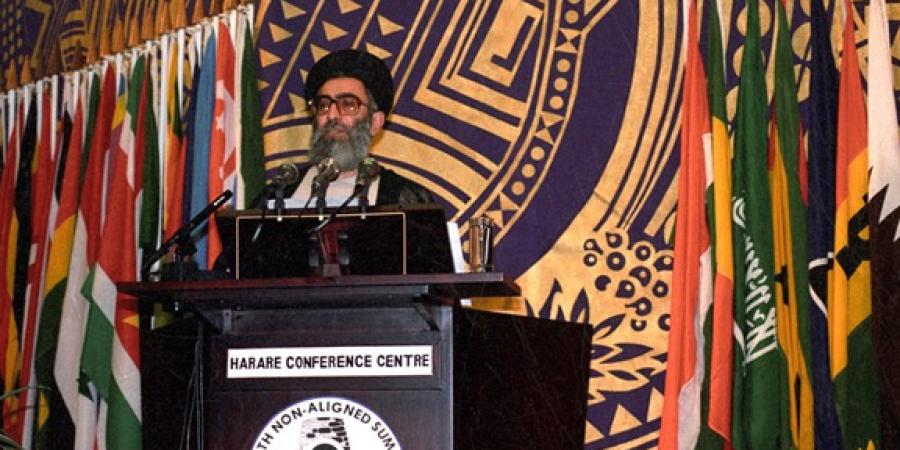
The following is the full text of the speech delivered by Imam Khamenei in the Eighth Summit of the Non-Aligned Movement (NAM) during his presidential term in office. This meeting took place in Harare, the capital of Zimbabwe, on September 5, 1986.
In the Name of God, the Compassionate, the Merciful
"O mankind! Indeed, We created you from a male and a female, and We made you nations and tribes that you may know each other. Indeed, the noblest of you in the sight of Allah is the most Godwary among you" (Quran 49:13).
Honorable Chair, esteemed participants, ladies and gentlemen,
I begin my remarks with the good remembrance of the prophets, who were the teachers, mentors, and guides to divine values for humanity. Peace be upon them and all those who devoted their lives and struggles to human ideals and who kept aloft the banner of freedom in the midst of storms. They said “no” to domination based on gold, coercion, and deceit, so that they could say “yes” to the just demands of the oppressed. And despite the pressures and cruelty of history’s tyrants and aggressors, they kept their lofty ideals alive and passed them on to us.
I would like to extend my congratulations to Zimbabwe on their assuming the chairmanship of the Non-Aligned Movement, and in particular to Mr. Mugabe. I wish him complete success in fulfilling the sensitive, important responsibility of guiding the Movement toward the realization of its noble objectives.
The prudence and competence of Zimbabwe’s leadership in governing this newly independent country, in confronting the challenges that arise due to the grim legacy of colonialism, as well as the steadfastness and courage of this country in facing the savage threats and pressures from the racist regime of South Africa and Global Arrogance, all affirm the appropriateness of the choice made by the Movement at one of the most critical junctures in its history. I hope the hardships and sacrifices that this great nation has endured on the path to independence will serve as a guarantee for the Movement’s advancement on a path leading to the complete elimination of colonialism, racism, and domination.
The sincerity, friendship, and feelings of solidarity that – God willing – fill the minds and hearts of our gracious hosts, together with the cheerful, promising atmosphere and the warm, friendly hospitality extended to all participants, are undoubtedly the result of revolutionary sincerity and the fruit of a great movement and transformation that has elevated this beautiful, blessed country from being an oppressed colony with a belittled nation to the presidency of the largest assembly of nations in the world, making it worthy of such a valuable trust. On behalf of the Islamic Republic of Iran, I sincerely thank all those who have worked tirelessly to prepare the groundwork for this summit over the past several months.
The holding of the Eighth Summit in Zimbabwe, which coincides with the passing of a quarter-century of the Movement’s existence, is a propitious coincidence that holds symbolic meaning for the Non-Aligned Movement in several respects.
First, newly independent Zimbabwe is one of the most significant places that’s severed the last lifelines of old colonialism. In other words, the Non-Aligned Movement has entered a new stage in its history. From this point onward, it must define and pursue new objectives and responsibilities that are suited to the current needs of the Third World.
Second, our presence in one of the countries that’s on the front line necessitates greater attention and a more serious approach to the issues related to the racist regime of South Africa, its aggressions against the countries of this region, and the question of Namibia’s independence.
Third, this presence in the African continent, which has suffered the greatest harm at the hands of colonialism and the plundering policies of Global Arrogance, provides a basis for determining the priorities of this Summit’s work, particularly in laying the foundations for the Non-Aligned Movement’s economic policies for the coming period. The natural desire and expectation we all have is that the Movement devote itself to solving Africa’s problems too during this term. Our interests are interlinked. The Third World is a body in which the independent life of its members is inconceivable. Protecting the lives of influential members like Africa is a priority for us, of course.
This gathering holds special significance for Africa, which is the greatest victim of hegemonic policies; for Southern Africa, which is the greatest victim of racism; and for the people of Zimbabwe, who have demonstrated remarkable generosity in providing for both the material and spiritual needs of this summit despite the unfavorable economic conditions prevailing in the continent.
I beseech God, the Almighty and Wise, to make this valuable opportunity a source of goodness and benefit.
Mr. Chairman, the eighth term of the Movement is beginning under exceptional, critical circumstances. While a vast portion of the world’s economic resources and wealth is being squandered as a result of the arms race between the East and the West and the tensions that exist between the two poles, the growing divide between the North and the South remains the most pressing global issue. The terms for the trade of raw materials and industrial goods have shifted further to the detriment of the Third World. The export of crises and tensions has been accompanied by an exponential increase in arms exports to the Third World. As a result of this compounded injustice, the concepts of growth and development have turned into unattainable, impractical slogans in many regions. The plundering of the Third World’s wealth using debt crises has extended its harm to affect the interests of future generations too.
The overt methods of old colonialism have been replaced by more covert, sophisticated, effective approaches. Militarization, the use of force in international disputes, violation of genuine human rights, breaches of humanitarian regulations and international law, the weakening of the multilateral system, the two existing poles' intolerance with respect to independent systems, the global nuclear threat, the production and use of weapons of mass destruction and conventional arms, and the destruction of the human environment and natural resources have all reached new, perilous heights.
Moral crises, which are in fact the foundation of other global crises, threaten humanity today more than ever before. Estrangement from the values of divine religions – values which are the most reliable criteria for regulating human behavior – has led to moral anarchy and has gravely shaken the cultural foundations of societies. The spread of corruption and moral depravity has accelerated, and the family – the cornerstone of society and the basis for the continuity and survival of generations – is in a state of instability and catastrophic moral laxity.
Success in confronting and combating the explosive situation we face depends on urgent, continuous, comprehensive, global efforts. This opportunity must therefore be used in the best possible manner, otherwise, a substantial portion of the responsibility for the continuation of these crises will be on our shoulders.
Mr. Chairman, esteemed heads of states and governments, honorable delegations, and distinguished guests, let us view our vast, troubled world from a viewpoint that’s beyond temporary, local, regional issues for a moment. This doesn’t mean trivializing or seeing those problems as being unimportant. Each of them has crushed a nation under unbearable pressures, imprisoning millions in a hell of injustice, poverty, hunger, war, disease, and ignorance. Rather, the goal is to ascend to a summit from which we can observe the origin and framework of all these sorrowful phenomena to recognize the flawed, distorted structure that governs current political and economic relations in the world and the mindset of both the oppressors and the victims. This is a monumental task, requiring great resolve and unwavering hope from those who understand this reality. But without a doubt, it will also reveal to us the true, definitive key to solving all these problems, keep us safe from going astray, and prevent us from losing sight of the true front and mistaking friend for foe.
In just one sentence, the main problem is that the world has accepted the system of domination. Let us move beyond words and frameworks, confront claims and slogans with actions and policies, and let’s not take the rare, few exceptions as the standard. … We will then see that not only the major powers – the superpowers, those who divide the world and prioritize their own interests even on the far side of the globe over the interests of countries and nations, and then they pursue their own interests as if they’re justified in this – but even those very countries, nations, and leaders themselves have submitted to domination. They treat the priority of the dominators’ interests as being an inescapable inevitability.
If the system of domination was manifested in the form of imperial military campaigns and enslavement in the past, today it appears in the form of a highly complex, global network that involves numerous aspects and domains of nations’ lives. The hegemonic system has succeeded in creating its own distinct economy, its own special political relations, and above all, a culture of domination. So if military readiness and defense were sufficient in countering imperial domination in the past, today even the mere awareness that one is being dominated requires serious effort and activity. Furthermore, confronting it has truly taken on vast dimensions.
Due to the mere virtue of possessing the tools of power, today the aggressors in the world impose their will, interfere, pass judgments, unilaterally determine the economic system and trade relations with the weak, and even interpret lofty human concepts such as freedom, human rights, terrorism, and the like according to their own desires. In short, everywhere their actions are based on their own interests and discretion. And nations, governments, and leaders in the world of the weak regard all this as if it were a heavenly decree or an incurable affliction. At the most, they accept it after some questioning and minor adjustments.
The most abhorrent phenomenon of the present age in history is that underdeveloped countries have no room for maneuver except to the extent of escaping from being used for the of interests of one great power to being used for the interests of another. Thinking and deciding freely, independently, and for oneself, while disregarding the demands, interests, and opinions of the world's aggressors, is precisely the great deficiency that exists in the world today. The Arrogant Powers in both the East and the West are expanding and growing larger by way of their injustices every day, and the balance of power between the strong and the weak is shifting increasingly in favor of the strong day by day.
No one will remain immune from the harm of the hegemonic system, which is gradually becoming more pervasive. Unfortunately, the roots of this dreadful trend lie within the Third World itself due to: the weakness of the leaders’ determination, fear of directly confronting the Arrogant Powers, relying on the aid of those powers, a lack of faith in the power of the people, and not relying on the people. These are the chief sources of the passivity and weakness of developing countries and are also the main factor helping the expansion of the Arrogant Powers. A solution must be found.
There was a time when nationalism and Marxism sparked hopes. But the former turned into "a pretext for igniting wars between nations that share the same pains," and the latter became "a means for forming a new empire," intensifying conflicts and the division of the world into blocs. The result was them trampling on and enslaving nations. And this will always be the case with any ideology that’s founded on the shaky pillars of materialistic thought.
The culture of domination has caused weak nations to become submissive and addicted to oppression. They must be healed from within. A deep belief in human dignity and strength, in God, in true human values, and in the nothingness of tyrannical powers must be instilled in people, and they must be armed with this indestructible weapon.
Islam and all divine religions guide human beings toward such a faith and in a direction entirely opposite to the culture of domination. The inviolable Islamic texts explicitly instruct people to "neither oppress others nor accept oppression." They teach that oppression and submission to oppression are at the same level, and the oppressor and the oppressed are partners in crime. Being a spectator to oppression and remaining indifferent to it are akin to oppression itself and are a stage of it. Reliance on God’s infinite power and having unwavering faith in people is another lesson that Islam teaches to nations and leaders, encouraging them to stand firmly against global domination and kindling a hope of success in them.
This great lesson of Islam has manifested itself in the past and present world time and again, becoming an established, undeniable reality that wherever nations or leaders have refused to yield to the advances of aggressors and have accepted the risks and hardships this entails, all the tools of the powerful have been rendered ineffective, and the path of the aggressor has been blocked. The victorious liberation movements of recent decades, along with Lebanon and Afghanistan today, are tangible, unforgettable examples of this claim.
The Islamic Revolution of Iran and the establishment of the Islamic Republic stand as a living, extraordinary testament to the falsehood of the notion that global hegemonies are invincible and that their will and desires are inevitable. The great message of our Revolution to strong nations is that bowing to the hegemonic system and the will of the powerful simply because they possess power is both wrong and sinful, and it’s actually the greatest thing that enables illegitimate domination.
Our great Islamic Revolution regards the secret of its success in its monumental trial to be its earnest, genuine reliance on the infinite divine power and upon the people, while deeming opposing, aggressive powers to be defeatable. With this spirit, we openly, fearlessly repudiate the global system of oppression and submission today. We regard this to be our duty, and we are extremely hopeful about the advancement of this.
The application of this heavenly command, as well as the explicit directives of the Prophet of Islam (pbuh), tells us that in the realm of international concepts and relations we cannot remain neutral in the face of the aggressions taking place in any corner of the world, even if it doesn’t directly affect our national interests. If the Third World were to heed this principle, the current disunity in confronting imperialist incursions would no longer exist among us. Why doesn’t the Non-Aligned Movement officially declare that if its members take a stance of neutrality in the face of any form of aggression, this is unjustifiable and a violation of the Movement’s principles?
At this point, I wish to present my views in assessment and evaluation of the current state of the Movement, drawing upon this very principle – the condemnation of the hegemonic system and the system of oppression and submission.
Mr. Chairman, the very emergence of this Movement was an act of defiance and uprising by independent Third World countries against the hegemonic system. Even today, the Third World knows of no better framework for mobilizing and organizing its efforts than the Non-Aligned Movement. In order to evaluate its achievements and shortcomings, we must examine what the Movement has done on this path – namely, rejecting the system of domination and replacing it with just relations. Let’s learn from the past and build the future based on this.
In the quarter-century that’s passed since its inception, the Non-Aligned Movement has made notable accomplishments. The Bandung Conference’s impact on intensifying and accelerating anti-colonial struggles led a considerable number of Third World countries to find security and independence by joining the Movement. The Movement’s stances in support of freedom movements and anti-colonial struggles have been a commendable and perhaps unique step on the international stage in dismantling the hegemonic system dominating the world (particularly in its worst form, which is military domination). Although the Movement has shown less vigor in preserving the achievements of such movements – namely, the nascent revolutionary governments by the people – it has nonetheless played a role.
In countering the economic domination of developing countries, the Movement has advanced the proposal of a New International Economic Order since the 1970s through considerable effort. This in itself has brought about broad international awareness, and if subsequent steps are planned with earnestness, there is hope that this will have a significant impact on breaking up the dreadful economic network that holds sway over the Third World.
In the 1970s and 1980s, when tensions between the two poles (the Cold War between the Eastern bloc and Western Bloc) were at their peak and the nightmare of humanity’s annihilation due to a nuclear war deeply terrified human society, the Movement contributed to reducing prevailing tensions to some extent with its peace-seeking ideas and by advocating disarmament negotiations, while also aiding global enlightenment. In addition to these achievements, we must mention the fact that the Movement’s influence in the United Nations has gradually increased to the point where the vote of the Non-Aligned nations has emerged as a collective force. On the one hand, this has endangered the vast dominance of the superpowers over the United Nations, and on the other hand, it’s demonstrated – albeit to a very limited extent – the power of nations. A sense of alarm among the superpowers has been fully evident in the recent confrontations between the United States and the United Nations.
These are the positive points.
But thinking realistically, we must also address the shortcomings of the Movement and examine them honestly without the constraints of polite formalities. This will help us in our seeking a new path for the future.
Mr. Chairman, is there any crime more heinous than the military occupation of a country or an act of aggression aimed at gaining political and economic domination over a nation? In the past quarter-century, a number of disadvantaged Third World nations and their nascent popular governments have been the victim of such actions. Has the Movement been able to bring strong international pressure on the aggressors in such cases? The Movement has often refrained from even taking a clear stance, which is the least that is expected of it, and it’s acted conservatively in those cases.
Of course, the Movement isn’t expected to enter the battlefield like a military alliance, but it’s expected to courageously, sincerely defend the Truth, the oppressed, and the victims of aggression and others seeking to dominate them. Nations expect that the Movement won’t be tainted by the schemings of great powers and that common diplomatic ploys and hypocritical tactics won’t be a part of it.
In the field of economic domination, we witness today how developed industrial countries take the raw materials and natural resources of developing countries at whatever price they themselves determine, and they use their cheap labor in whatever manner they wish. Then they sell their industrial products to these countries at whatever price their economic interests dictate.
The vast, sinister economic network connected to the superpowers has so thoroughly taken control of the affairs of nations that this thought gradually grows in minds that there is no longer any hope for salvation. The culture of domination secures the economic interests of the hegemonists from every direction. If a liberation movement begins somewhere and a nation awakens, they first employ every kind of trick to subdue it. If that nation is victorious despite their efforts, a military, economic, political, propaganda onslaught begins.
Just look at what the Great Satan is doing in Nicaragua! And look at what it has done and continues to do against the Islamic Revolution of Iran! Unfortunately, in the face of all these crimes and disgraceful activities, the expected, necessary action isn’t seen from the Movement.
Mr. Chairman, allow me to state frankly that the root of this dangerous weakness in our Movement lies in two things. First is the abandonment of its fundamental principles, and second is the lack of a sense of responsibility among its members with regard to global issues. Among the members of the Movement today, there are countries that cannot even mention the name of the principles of the Non-Alignment Movement among their own people, because their country is a center for foreign incursions, their wealth is plundered daily by dominant powers, and their government is a puppet of those powers. Can one expect such governments to rise up against domination? There are also other countries that enjoy a relative independence, but they’ve preferred comfort over their global responsibilities and have purchased today's security at the cost of tomorrow's submission.
Mr. Chairman, as the president of a country whose system is the fruit of a vast, bloody, popular uprising against the greatest tyrants of our era – that is, US imperialism –whose government is the courageous standard-bearer of divine values, and which has been the target of all kinds of assaults by world powers and their agents from the very first day, with all the respect and conviction I hold for this Movement, I must sound the alarm that if the Movement doesn’t undertake a fundamental, structural measure to resolve its deep-rooted problems, its future will be in serious jeopardy and nations’ hopes in it will be dashed.
Such action and such reform can revolve around certain principles, which I shall now present. These proposals are the product of experience backed by many years of relentless struggle against imperialism. Among its achievements is the astonishment it has caused among great powers regarding the force of resistance and the ability it has had to win the hearts of nations.
The first necessary step is reviving the principle of the Non-Aligned Movement. This is a comprehensive, complete matter.
So first, the governments that are members of the NAM must fully adhere to its principles in their relations with other states. Its core spirit is resistance and rejection of all forms of domination. It is absolutely meaningless for governments to be members of the Movement but provide military bases or the necessary means for economic, political, or cultural domination to the superpowers at the same time. Worse still is for them to participate in military aggressions or for them to launch economic attacks.
Second, the idea of non-alignment and the will to resist the onslaught of domination must be widely promoted among nations. There is no better support for seriously confronting the Domineering Powers than the readiness of the people.
The second necessary action is to revive the spirit of having a sense of responsibility with regard to global issues among all members. The Movement must be the standard-bearer of justice and opposition to domination in the world. If the power to directly prevent aggressions and assaults against nations is lacking, there must be at least a resounding outcry against the aggressors and oppressors, and there must be defense of the rights of the victims of oppression and domination.
This is a source of disgrace that during this past quarter-century so many aggressions and betrayals have been committed against various countries – especially against those governments born from a revolution and widespread popular movements, which have attained freedom and non-alignment through sacrifices – but the NAM has failed to take appropriate action. The presence of such a spirit and sentiment [of taking action] can serve as a value and as a precedence among the members of the Movement.
Indeed, why shouldn’t there be any difference between those countries that through many years of a bloody, popular revolution have succeeded in overthrowing a tyrant, shattering the domination of the superpowers, and joining the ranks of the NAM, and those countries whose presence in the Movement undoubtedly remains ceremonial if they aren’t actually serving the interests of the powers that exist? The Movement must be a model of courage and resolve in defending the rights of Third World nations and breaking up the network of domination. But this cannot be attained by way of customary expediencies.
The third fundamental issue is the expansion of the scope of the activities of the Non-Aligned Movement. Since the activities of the hegemonic system aren’t limited to the political sphere but have also managed to create their own distinct cultural logic and a dependent economic and propaganda network, the defense in fighting against it must also be comprehensive. In our view, it’s the human element of mankind that’s the central axis. Therefore, efforts with a cultural dimension should be an extensive part of the effort. On the other hand, increasing the political awareness and insight of nations will serve as a strong barrier against the destructive flood of the culture of hegemony, which paves the way for military, political, and economic infiltration and sustains the network of domination.
Under the hegemonic system, the economy of the Third World has fallen into its current parasitic state. Due to this, Third World governments have been forced to submit one after another to political domination in exchange for temporary economic concessions.
This is while the Third World possesses abundant God-given wealth. Raw materials, energy resources, and natural reserves are given freely to the world’s economic powers. Why? On the surface, it appears that scientific, cultural, and industrial backwardness is the reason for this. However, the spirit of it is influenced by the octopus-like system of domination. Through the collective adoption and implementation of special programs, the Non-Aligned Movement can and must earnestly confront the danger of the Third World’s submission to economic powers. To establish logical, just relations between developed countries and the Third World, the Movement must fulfill its fundamental duty by facilitating cooperation between its members.
The fourth matter is the formulation of practical criteria and guidelines based on the principles of the Movement for addressing international events and issues in a principled manner. Such issues are numerous and varied, and the Movement cannot examine each one separately. Beyond the impracticality of such an approach, it also brings the danger of a dichotomy in judgments on similar matters. Unfortunately, we already have multiple examples of this. The issue of aggression, the issue of prevailing economic relations, and the corpus of international law are some of the highly sensitive, essential areas at present. Additionally, regional cooperation within the framework of the Non-Aligned Movement and the establishment of regional groupings to counter the aggressions of the two blocs, to assist in the progress and development of countries, and to address the shortcomings of the Movement’s executive power are of the utmost priority.
Allow me to point out one of the most important aspects here. The process of countries joining the Movement over the past quarter-century of its existence has accelerated significantly, and today the Movement encompasses most nations. So at this stage of its life, the Movement is undoubtedly obligated to do the following.
First, formulate a political, cultural, and economic policy for the administration of world affairs, and instead of just confronting problems, it must actively, effectively intervene in shaping the course of the global community.
Second, it must pursue a new goal in its historical struggle. That is, it needs to open a cultural, value-based front. The powers that were victorious in World War II, particularly the leaders of the two political blocs, have imposed their own frameworks of values, ethics, and culture on other nations using existing international relations and laws, most of which were created in the post-war period. The Third World has played a secondary role at best in shaping these frameworks of values. The Universal Declaration of Human Rights and the judgment criteria of international organizations regarding human rights issues aren’t influenced by divine or Third World values at all.
Third, it must regulate relations between non-aligned countries independent of the materialistic values of non-Third World entities. The majority of votes in most international forums belong to us. This power must be exercised for forming international laws. Unfortunately, not only the Non-Aligned Movement but all international institutions have left their adopted rules and regulations without any mechanism to ensure their enforcement. As a result, violations of international regulations and laws have increased in proportion to growing ambitions and interests. Third World countries have suffered more than others from these violations. The lack of cohesion among these countries has resulted in their facing the full weight of pressures and aggressions individually. The solution to this problem lies in the creation of a new system of international law.
This system rests on three foundations.
First, the common values of nations, equally and without discrimination, should constitute the basis for the development of international law. Although the non-aligned countries have succeeded to a large extent over the past 25 years in modifying existing international regulations in order to safeguard the interests of Third World countries, the imposition of the value foundations of major powers on the initial structure of the current system has ultimately fixed the outcome in favor of those powers.
Second, international regulations and laws must aim to ensure justice rather than preserve the status quo.
Third, a non-discriminatory character for these laws and regulations must be firmly guaranteed, and the current process whereby any decision contrary to the interests of one of the major powers possessing the right to “veto” is rendered impossible should be brought to an end. This veto power is the gravest weakness, and it has brought under question the entire usefulness of the United Nations. It is therefore appropriate to once more repeat the immortal slogan of “abolish the veto power,” and to emphasize that there is no justification whatsoever for the continuation of it.
In our view, it’s essential to establish permanent oversight of violations of international regulations in relations between members of the Movement and to devise a mechanism for adopting punitive policies against any form of aggression. Furthermore, the existing legal gaps, particularly in areas such as prohibiting the use of force, preventing aggression, adhering to humanitarian regulations during times of war or peace, upholding human rights, and banning the use of weapons of mass destruction such as chemical weapons, should be addressed through initiatives by the Non-Aligned Movement. Summits are a valuable opportunity for such an endeavor.
Mr. Chairman, the best criterion for assessing the effectiveness of the prevailing international system is to examine the history of South Africa and the conduct of international organizations in the face of the aggressions of the racist regime. Few governments in contemporary history have been such a comprehensive embodiment of vile traits as the racist regime, and few have been condemned and reviled to such an extent for their crimes. Therefore, no excuse remains for the inaction of international assemblies.
Yet, as the 20th century draws to a close, breathing space still remains for the continuation of the Pretoria regime's existence. The problem of South Africa isn’t just a problem for Africa. The violation of lofty human values in any corner of the world is an assault on the rights of all of humanity. Accordingly, the continued assistance given by the United States and certain European countries to the Pretoria regime, and their disregard for the comprehensive sanctions recommended and approved through tens of resolutions and declarations, must be seen and condemned by the Non-Aligned Movement as an infringement on the rights of all member countries and be subject to punishment.
In fulfillment of its Islamic, national duty, as well as its international responsibility, the Islamic Republic of Iran has not only halted the export of oil but has also imposed a complete, comprehensive boycott against the Pretoria regime. It has strived to devote the utmost of its resources and capabilities to the eradication of racism, the independence of Namibia, and support for countries resisting aggression on the frontlines. This policy must be adopted by all members without delay and established as a consistent course of action.
I propose that this Summit appoint a special committee, which is composed of representatives from various geographical regions, to continuously formulate and announce policies and methods for military, economic, political, and cultural action as circumstances require aimed at the complete elimination of the racist regime. Sooner or later, South Africa will come into the hands of its black majority with or without our help. We are obliged to contribute to this cause not because of their need, but for the preservation of our own humanity.
Mr. Chairman, we pay tribute to the struggles of the people of Namibia under the leadership of SWAPO. All non-aligned countries establishing diplomatic relations with SWAPO is the least of our duties, and I hope this will be realized in this Summit. Humanity's conscience is deeply distressed by what is taking place in South Africa. The existence of the apartheid system in the world in which we live is an affront to all of us, and it must be swiftly brought to an end.
The countries on the frontlines with their steadfastness and resistance have borne their share in the struggle for the freedom of the South African majority and the independence of Namibia in the most generous manner, inscribing golden pages in the history of the Third World. If support for the countries on the frontlines facing South Africa’s aggressions is limited under the present circumstances to just slogans, it will inspire neither admiration nor the attention of anyone. Southern Africa is weary of the hundreds of resolutions and declarations that have been passed against the Pretoria regime over the past four decades, which have only ended up in the archives of international organizations. Africa wants action today.
The Islamic Republic of Iran firmly calls for the Non-Aligned Movement to make the eradication of the Pretoria regime its primary goal during this new period. Zimbabwe, as the current Chair, must use the full capacities of the Movement for this purpose. For its part, in accordance with its international obligations and above all the firm Islamic directives that make defending the oppressed and repelling the oppressor a duty, the Islamic Republic of Iran offers its maximum capabilities and resources to this cause.
Mr. Chairman, there are very few regimes that can be found to be as similar to each other in both outlook and action as the apartheid regime of South Africa and the Zionist regime. Both have discriminatory policies toward the indigenous inhabitants. Both have continually carried out systematic aggression against neighboring countries. Both hold records for violating international laws and regulations, with more resolutions and statements issued against them than any other country. Both are clear examples of state terrorism, and both are primarily kept alive by the Great Satan [the US] and some other Western countries. This total similarity today has made these two regimes closer and more coordinated than ever. And it has made their policies complementary to each other. Consequently, adopting conciliatory approaches toward Zionism will yield no positive change whatsoever.
We believe the complete freedom of the land of Quds is impossible except through full-scale armed battle. Aggression isn’t one of the characteristics of these regimes that can be eliminated through negotiations. Rather, it is the very nature of these two regimes that demands such an approach. The idea of peaceful coexistence between the people of the region and such regimes doesn’t captivate the thinking of anyone but the naive.
Considering the recent visit of the Zionist regime’s prime minister to Morocco, I would like to particularly warn our African brothers that the policy of expanding the Zionist influence in Africa is a natural extension of the racist regime’s policies that will ultimately result in nothing but immense harm to the countries that establish ties with Zionism. The cooperation between these two regimes in the nuclear field is the greatest warning about the danger that threatens Africa and the Middle East alike. Like the issue of the racist regime, the problem of Zionism is a global problem, and the fight against both must be at an international level. The policy of the Non-Aligned Movement regarding both regimes must be in accord with a single, joint program and be ratified by the Summit as a binding measure.
Mr. Chairman, the Non-Aligned Movement must also adopt a clear policy regarding the issue of Lebanon and the necessity of the immediate, unconditional withdrawal of the Zionist regime’s forces and multinational forces. Fortunately, the unwavering, highly successful struggle of the Muslims of Lebanon against the usurping, occupying forces is an inspiration and model for us.
Before being a problem for the Third World, Lebanon is a lesson. The successful resistance of the Muslims of Lebanon against the presence of aggressive, foreign forces has best demonstrated that the blame for strengthening domination and imperialist aggression cannot be attributed anywhere in the Third World to a lack of material factors. The spirit of refusing to accept oppression is the only factor that can explain the success of the Lebanese Muslims’ struggle. Supporting this magnificent, epic struggle until the complete elimination of the influence of imperialist powers and the Zionist regime in Lebanon must be a fundamental element of the NAM’s unified policy regarding the issue of Lebanon.
Mr. Chairman, since the Middle East is of strategic importance and possesses vast energy resources, it has always been a focal point attracting the attention of the world powers, and it has continuously been subjected to their plots and aggression. The imposition of the Zionist regime in this region was intended to create continual tensions and to be a pretext for the constant intervention of these powers. Therefore, the emergence of the Islamic Revolution and the establishment of the Islamic Republic of Iran, which placed the destruction of the Zionist regime and the elimination of Western and Eastern interference and influence in the Middle East at the top of its stated goals, was considered to be a serious threat to the interests of these powers from the very beginning.
The Imposed War against the Islamic Republic of Iran has been the response used by the imperialist powers to this threat. The course of the war over the past six years, the flow of arm supplies to Iraq from both blocs, the flood of direct financial aid to Iraq from imperialism’s agents in the region, the silence of international bodies regarding Iraq’s clear violations of international law, the Security Council’s reluctance to address Iraq’s start of the aggression, and hundreds of other reasons and indications all confirm this undeniable reality that the emergence of a truly non-aligned country in a region that is intensely coveted by the major powers is intolerable to them and must be the subject of a comprehensive aggression. Iraq has been chosen and assigned to be the lever for implementing the imperialist policy in the region.
Mr. Chairman, war records show that Iraq took advantage of Iran’s situation after the Revolution. Under the impression that the Iranian army had collapsed, Iraq launched a wide-scale invasion to occupy Iranian territory and overthrow the Revolutionary government. A large part of Iran’s territory was occupied. Occupied cities, villages, and territories were reduced to rubble. Civilians were taken hostage or executed en masse. International regulations were violated one after another, and the Algiers Agreement, which had been signed between the current Iraqi regime and the Shah’s regime for resolving border disputes, was torn up by the head of the Iraqi government. Over the past two to three years, the repeated, wide-scale use of chemical weapons against humanity has continued without any regard for global public opinion. Cities and residential areas are subjected to repeated air and missile attacks. Even past generations haven’t been spared from these crimes against humanity, and their remnants, historical monuments, and humanity's cultural heritage have also been attacked. Thus, many records for historical crimes have been broken during these six years of the Imposed War.
Mr. Chairman, the tragic story of war cannot be summarized in a few sentences, nor can the depth of the crimes and aggressions of the Iraqi regime be measured. Aggression and crime aren’t quantifiable. No international principle or standard, no expert analysis, and no language or pen attuned to human emotions can convey – not even in a single case – the extent of the grief of mothers who in the final moments of their life, cradled in their arms their young daughters who had been raped, for a final farewell before being buried alive in mass graves. The multitude of bones uncovered from the mass graves in Hoveyzeh and Bostan, and the wails of thousands of children who shed tears of blood beside the bodies of their fathers and mothers in the ruins of Dezful, Behbahan, Marivan, and tens of other cities after aerial and missile attacks, all bear witness to the depth of this catastrophe.
Despite the fact that the Iraqi regime suddenly changed face and overnight became an advocate of peace immediately after the liberation of Khorramshahr and the humiliating defeat of their occupying forces, war records show that crimes against humanity and violations of the most basic human principles not only continued but also intensified after that. Some evidence of these crimes exists in European hospital archives. According to many international authorities, it [the Iraqi regime] is even worse than the likes of Hitler and Genghis Khan.
Mr. Chairman, if we add the hundreds of billions in material damages suffered by both countries to these tragedies, and if we include the loss of opportunities for development for both nations, we arrive at a shocking conclusion that no free-spirited human being can be indifferent to. A great injustice has taken place on a historical scale. History tells us that whenever warmongering, international aggressions go unpunished and justice is not established, the roots of war remain alive, waiting for an opportunity to show themselves again. Without ensuring justice, without eliminating oppression, and without destroying aggressive attitudes, calling for the peaceful coexistence of the oppressor and the oppressed means nothing but legitimizing oppression and aiding its continuation.
If the Islamic Republic of Iran finds a way to compensate for the billions in war damages, how can the lost lives of our country’s finest children and the missed opportunities for development during the Revolution’s best years ever be brought back? Some say it was merely a miscalculation about the Islamic Republic of Iran’s defense forces that provoked Iraq to start the war. Now that Iran has demonstrated its strength, such a miscalculation won’t happen again. This analysis is more like a joke because what is a threat for any country’s national security is the existence of aggressive, domineering tendencies on the other side of its borders. Otherwise, miscalculations can occur anywhere and at any moment. From the time the Iraqi regime came to power through a coup, not only the Islamic Republic of Iran but most countries in the region haven’t been safe from its aggressions for even a moment.
Mr. Chairman, a war of aggression that’s initiated by anyone or for any motive is equally worthy of condemnation everywhere. Thus, the direct warmongering of imperialism is just as detestable as the aggression of its puppet agents. When every small personal crime is consistently deemed worthy of punishment, can it be acceptable for a massive international crime to go unpunished? Can the conscience of the global community accept that an aggressive regime burns hundreds of billions of dollars of the wealth of two developing countries; kills tens of thousands of men, women, and children; and is the cause of the worst tensions in the world’s most strategic regions?
Can this be acceptable that a regime violates most major international regulations, then when it is on the brink of collapse as retribution for all its crimes, it claims to seek peace and mocks the intelligence and awareness of countries' representatives in international assemblies? Can one believe that history is a contract that can be rewritten based on the needs of the day and the interests of major powers? How did the war begin? It seems some people have "constructive" suggestions for changing history and the narrative of the war.
No matter how constructive such proposals may be, they cannot help us convince the grieving parents and orphaned children of Iran that the loss of their loved ones was a mere illusion. Less than a generation has passed since the war was started by Iraq. We have witnessed the history and atrocities committed in the war with our own eyes, and we have felt them with our very flesh and veins. It’s difficult for us to deceive ourselves. Those who believe that realities can be reduced to mere agreements would do better to begin their attempts at rewriting history elsewhere. Concerning the events that took place in past generations, they can write and deliver speeches about the peace-loving, humanitarian, constructive qualities of Hitler or Genghis Khan.
Mr. Chairman, in accordance with our Islamic, national duty, and also according to the fundamental principles of the Movement, the Islamic Republic of Iran is obliged to bring the warmongering Iraqi regime to justice. Of course, the spiritual damage inflicted on both the Iranian and Iraqi nations is so immense that compensating for this is undoubtedly impossible. Moreover, in view of Iraq’s continued violation of all international regulations and the bitter reality that this regime attaches no importance whatsoever to its most essential obligations, no international guarantee can be effective in preventing Iraq from launching another attack against the territory of the Islamic Republic of Iran. Consequently, Iraq, which is the initiator of the war, also bears responsibility for its continuation.
The inability of international bodies and authorities to address the issue of the war decisively is itself a significant factor contributing to its prolongation. Despite the passage of two terms of the Movement’s presidency, the Imposed War has yet to reach a just conclusion. This shows that the current international system has been unable to address the conflict in a principled, practical, realistic manner. The core of the problem lies in the absence of attention and due regard for the element of justice in the solutions proposed by international assemblies and by countries wanting the restoration of peace.
At the time when Iraq was in a position of power, neither international assemblies nor the countries of the world took measures to prevent aggression or establish peace. But now that the courageous resistance of our fighters has altered the course of the war and the Iraqi regime faces the prospect of inevitable defeat, calls for peace have emerged from all directions. It has become evident to us that the objective of many mediators is merely to rescue the aggressor rather than to establish peace and justice. Consequently, the responsibility for upholding justice, which is an international obligation in response to any form of aggression, has rested entirely on the Islamic Republic of Iran throughout the entire duration of this war.
Unfortunately, one of the problems we face stems from the double standard in judging the fundamental issue of the war itself. For instance, while in the London Declaration of 1942, the Allied Powers deemed the prosecution of Hitler as a war criminal to be one of the most important objectives of continuing the war, which in itself constitutes a legal precedent in this matter, no comparable judgment or decision was made with respect to Iraq’s similar actions during the war.
The same countries that regarded the use of nuclear weapons by the United States in Hiroshima to be a justifiable response to the start of a war, after five and a half years since Iraq started the war and only as a result of public pressure, have finally acquiesced to making a very faint reference to the crime of starting the war. Instead of using an explicit term, they have used the term "initial acts" in the Security Council’s most recent, unjust resolution. Unfortunately, this same double standard has also been observed in the stances taken by some non-aligned countries.
Throughout the entire course of the war, the Iraqi regime has repeatedly violated key international regulations – such as the prohibitions on the use of chemical weapons, attacks on residential and civilian areas, attacks on cultural institutions, attacks on civilian air and sea transport, and the mistreatment of prisoners of war. All of these have been documented in United Nations reports. But despite the Iraqi regime committing all these crimes, it hasn’t faced the slightest international condemnation. Regrettably, in their response to these crimes, some non-aligned countries have even lagged behind the Security Council with all its biased judgments.
I wish to state frankly that if the NAM cannot punish the crimes of the Iraqi regime, which are so clear and well-documented, and it cannot take a clear, just stance against them, then no real hope can be placed on its ability to stand against the aggression and domination of the major powers or its ability to have a meaningful effect in the face of major global tensions and crises. The Non-Aligned Movement should take action against the Iraqi regime on several grounds: its aggression against a revolutionary, non-aligned country; its violation of all international regulations, which has created tensions; they’ve explicitly invited superpowers to intervene in regional affairs; and its squandering of the region’s material resources for the benefit of both blocs and to the detriment of the Third World.
Mr. Chairman, committing just one of these crimes is sufficient to expel a regime from the Movement. The Bandung and Belgrade Declarations explicitly declare that starting a war is a crime against humanity. In that case, how can the continued membership of Iraq in the Movement be justified? Have we retreated from the positions of Bandung and Belgrade? While the Belgrade Declaration unequivocally, unconditionally prohibits the production and use of chemical weapons, Iraq has employed such weapons on a large scale more than three times even after being condemned by the Security Council on March 21, 1986. To what extent can the violation of the principles of the Non-Aligned Movement be permitted to continue?
It therefore follows that at a minimum, the Movement is obliged to:
- Expel the Iraqi regime from its membership;
- Draw lessons from this destructive war in order to prevent the outbreak of similar wars of aggression; and
- Formulate, adopt, and enforce a program to punish violators of the principles of the Non-Aligned Movement in all areas.
We don’t have the right to show the slightest leniency in the punishment of such a crime for the sake of immediate bilateral considerations and interests. The slightest negligence in this regard means nothing but the encouragement of aggression and the endangerment of security and peace for present and future generations. Our nation is determined to prove once and for all that it won’t accept oppression at any price. And on this path, it knows no limits for sacrifice and selflessness.
At the same time, we are prepared to take the lead in any course that leads to the establishment of a lasting peace, the eradication of the roots of war and discord, and the establishment of peaceful relations with all countries in the region. Peace, in general and especially for our sensitive region, is not a matter of choice. Rather, it’s a vital necessity. We have no choice but to guarantee the establishment and fortification of such a peace in the region through the decisive punishment of the aggressor, the warmongering, extortionist regime of Iraq. This must be done in such a way that all countries' fear of aggression is replaced by confidence and tranquility, and the vast economic resources of the region are dedicated to development, progress, and self-sufficiency.
Mr. Chairman, it’s no exaggeration to say that the price of tolerating oppression in the face of the establishment and aggressions of the Zionist regime has been paid in Afghanistan. Tolerating the Zionist regime in our region has emboldened a superpower to attempt the occupation of yet another part of the Islamic lands and to impose an anti-Islamic regime on it. The major problem of Afghanistan still stands before this Movement.
Unfortunately, the unconditional, immediate withdrawal of the occupying forces is still far from being realized. The NAM cannot continue to spend its time merely recommending the need for the withdrawal of occupying forces. The Movement’s job isn’t to offer repeated, fruitless admonitions to the superpowers. I would like to strongly emphasize that the Movement can make no distinction between the struggles of the Muslims of Lebanon, Palestine, and Afghanistan, or of those of Namibia, in their fight to expel foreign occupation. Based on principle, the Movement cannot support puppet regimes installed by the superpowers. The liberation movement, the independence-seeking movement in Afghanistan, must be granted representation in the Non-Aligned Movement like all other liberation movements.
Unfortunately, the Movement's approach to the issue of Afghanistan hasn’t been consistent with its approach to other similar cases. If the Movement tolerates the military occupation of one of its member states under any pretext, it has deviated from its principles in the most obvious way. The presence of five million displaced Afghans and refugees in Iran and Pakistan is indicative of the internal situation in Afghanistan. The Movement mustn’t allow the fate of Afghanistan to be used as a bargaining chip between the East and the West. Furthermore, any US effort to replace the current occupying forces isn’t acceptable in any way. Afghanistan must be independent and truly non-aligned.
Mr. Chairman, the situation in Latin America demands the immediate attention of the Non-Aligned Movement in at least one respect, and that is the recent ruling by the International Court of Justice against the illegal actions of the United States in supporting the Nicaraguan counter-revolutionaries. The US’s reaction to this ruling show more than ever that international standards and regulations are under an unprecedented assault by major powers. It also demonstrates that international bodies and institutions are respected only as long as they unconditionally serve the interests of those powers. And finally, it’s proof that the movement of countries toward non-alignment will inevitably be met with the opposition of the major powers.
Taking practical measures to support nascent non-aligned countries is an undeniable necessity. The Movement has a duty to rise up and take action in the defense of revolutionary Nicaragua.
Mr. Chairman, the ruling of the International Court of Justice on the one hand, and the US’s claim to be fighting terrorism on the other, create an utterly ridiculous picture. In practice, of course, there is no contradiction to be seen in these policies. Reagan’s [so-called] anti-terrorism campaign is nothing but the US’s program to crush liberation movements. The US’s attacks on Libya and Nicaragua are the clearest proof of this fact.
The Non-Aligned Movement mustn’t be passive in the face of threats against its members by the major powers. In response to these threats, the Movement can and must formulate and implement a coherent policy for protection with enforcement guarantees to support the countries of the Third World.
We call on this Summit specifically to:
- First, strongly condemn the cowardly US attack on Libya, which is a clear example of state terrorism.
- Second, examine practical defense mechanisms in response to the collaboration between certain European countries and the United States.
Mr. Chairman, satellite espionage is a new, dangerous dimension in the imperialists’ aggression against the Third World. We believe that not only should outer space not be contaminated with nuclear and conventional weapons, but the use of space for espionage purposes must also come to an end. While wiretapping and espionage are considered prosecutable crimes in all countries, it’s unacceptable that prying, ill-intentioned eyes and ears should use satellite capabilities to constantly monitor the slightest movements of countries and nations and then use such information against them.
In view of the recommendation made by Mr. Mugabe, the chairman of the Summit, with regards to limiting the length of our speeches, I will not read parts of my address but will instead submit them to the Summit to be included as a part of the Movement’s documents. Now, considering the opportunity I have been given, I would like to conclude by offering a brief response to a statement made yesterday by one of the attendees regarding war.
In his eloquent remarks today, Mr. Mugabe rightly pointed out that it’s very regrettable that most of the world’s centers of tension today are on the soil of non-aligned countries. Please let me add this fact that the main factor in all these tensions is aggression and the spirit of aggression. Therefore, I think we all share the belief that confronting aggression, preventing acts of war, and subduing aggressive policies must be the central focus of the policies of the Non-Aligned Movement. This is the same principle that is noted in the first article of the United Nations Charter and the second principle of the five important principles of non-alignment.
Referring to the Imposed War, he requested that the Islamic Republic of Iran accept mediation. It’s necessary to remind him of a few points:
- It’s a definite, undeniable principle that the responsibility for the continuation of any war rests entirely and directly on the party that started it.
- Any position that’s not in line with Article 1 of the United Nations Charter and the principles of the NAM, which are based on eliminating the aggressor, will only help in the establishment and continuation of aggression. Therefore, such a position amounts to assisting the aggressor.
- According to international principles, the elimination of aggression is a shared international responsibility and takes precedence over any other action.
- Without punishing the aggressor and restoring the rights of the victim of aggression, ensuring justice is inconceivable.
- The attack on our country was an attack on a revolution, and our defense was the defense of a revolution.
- The support of NAM members for the victim of aggression is both a responsibility and a duty under the principles of the NAM, and violating this duty is a violation of the important principles of the Movement.
If the Non-Aligned Movement today gives certain individuals the opportunity and permission to participate in the gatherings of NAM leaders on behalf of the nation of Palestine that has witnessed such aggression against it, it’s precisely and solely on the basis of this principle. Calling into question the implementation of this principle casts doubt on their own presence here.
8. In his address yesterday morning, one would have expected that he speak of the successes achieved by the Palestinian people in their battle against the aggressions of the Zionist regime rather than attempting to encourage others to support aggression.
9. Unfortunately, it is precisely this outlook that has caused Palestine to still be a victim of aggression after four long decades.
10. If he believes in this failed method and policy of submission and compromise with the aggressor for Palestine, he would be well advised to seriously refrain from recommending it to others.
11. For the Islamic Republic of Iran, any position advanced by anyone that fails to uphold the aforementioned principles is unacceptable, ineffective, and not impartial.
Allow me to conclude by citing a quote from September 28, 1980, a time when a vast part of our Islamic homeland was under the occupation of the aggressor. A person whom he knows well said in an interview:
"I wish to state before you and before the Arab nation that we have rejected the efforts of certain Arab officials to mediate. None of the Arabs should take a position of mediation. If they aren’t prepared to support their Arab brother in the war, they should at least remain silent. That is our minimum expectation."
Mr. Chairman, despite the passage of a decade since the proposal of a New International Economic Order, and despite some optimism regarding the North–South negotiations, in action it has been proven that the success of these negotiations is contingent upon granting numerous concessions, especially political ones, to the North. As was made clear during the recent special session of the United Nations General Assembly, the West has openly demanded the right to intervene in the political and economic systems of countries in exchange for economic aid to Africa.
With the drop in oil prices, the West's big lie was exposed. It became clear that the existing economic crisis, which was continuously being exported from the industrialized world to the Third World, was in no way the result of rising oil prices in the 1970s. Rather, it stemmed directly from exploitative economic policies. In the current circumstances, the South isn’t armed against the global crisis-creating policies. We must follow our own independent path and not be swayed by temporary economic pressures. For its part, the Islamic Republic of Iran has taken steps in this direction. We take pride in the fact that we haven’t taken loans from any foreign country despite the immense economic pressures of war.
The Islamic Republic of Iran has striven to not follow any imported model in the path of its economic development. Our banking system, which isn’t based on usury and which adheres to the clearest injunctions of the Holy Quran, has yielded positive results and can be used by other countries. We hope this Summit will earnestly dedicate itself to discovering effective ways for expanding South-South cooperation.
Mr. Chairman, the independent movement of the South requires a cultural and moral movement not only in the economic field but in every field. What compels human beings to fight against oppression, exploitation, the system of domination, and injustice in general, which leads to the emergence of a new system of social relations based on justice, are moral elements. Another reality is that the Third World has never been poor in terms of natural human talent and natural resources. The outcome of these two facts is nothing more than one thing.
The weakness of the Third World is a direct, immediate result of a weakness in morals and culture. In fact, not only the Third World but the entire world suffers from a crisis in morals. The path for the export of the economic crisis from the North to the South was opened by the export of immorality and a decadent culture to the South. The tangible achievements of the great Islamic Revolution of Iran, which is a cultural and moral revolution before anything else, confirm this.
The influx of a consumer culture, vulgarity, and lewdness into the Third World has not only always accompanied the import of industrial goods but has also taken place under the guise of bringing in science and technology. Fortunately, the Movement has succeeded in raising the social awareness of the Third World regarding the political and economic weaknesses prevailing in their countries and in international relations over the past two decades. However, the growth of awareness in the fields of moral consciousness and cultural movements hasn’t been proportional to the growth in those areas.
Addressing this shortcoming is one of the most urgent responsibilities of the Movement in the period ahead. We aren’t only forced to open a front in a moral and cultural battle against the influx of imported, decadent morality, we are also in pressing need of bringing about a fundamental, moral transformation that will be the source of our success in other fields. This must be done through cultural cooperation and the propagation of methods that are mutual for combating materialism, corruption, lewdness, and submission to oppression.
Mr. Chairman, at the end of my speech - although this is certainly not the least important topic - I would like to draw your attention to the situation of the non-aligned countries in international assemblies. As I’ve mentioned, today the non-aligned countries fortunately have a dominant voice in the international community. It’s precisely for this reason that those organizations and international bodies that have respected this voice and have striven to implement it have come under attack by the major powers.
The attack by the United States on UNESCO and its competent Director-General, its withdrawal from that organization, its attack on the world Food and Agricultural Organization (FAO), and its recent threats against the United Nations have multiple meanings and consequences. These attacks show how little respect the major powers have for the system of democracy in truth and have also exposed their great lie about supporting this system.
The use of financial leverage in response to the decline in votes favoring the US and several other Western countries in international forums has shown in the best way possible that rights are in proportion to force and money from the perspective of these countries, and that international organizations, like commercial enterprises, must attract votes for these countries in exchange for their investment. Despite the expectations of these countries, the non-aligned countries should welcome these events.
These moves have created a valuable opportunity for the non-aligned countries to expand their genuine participation in the administration of these organizations and to guarantee the implementation of their votes in various spheres of international activity. Therefore, serious support and backing for all organizations that have come under such attacks must be considered to be an important duty during this term.
Today, a multilateral system is an imperative. The NAM can and must play their role in the transformation of the multilateral system using the majority vote they possess. The continuation of certain structural weaknesses in international organizations, especially in the United Nations, isn’t justifiable. The structure of the United Nations Security Council must undergo a fundamental reform.
The agenda of the UN General Assembly must be reshaped in line with the needs of the Third World. We hope that during this term, we will witness the decisive success of the NAM in eliminating the shortcomings in international assemblies, which since the Second World War have hindered them from carrying out their primary duties in maintaining global peace and security and in creating the conditions necessary for the independent, free growth of nations.
Mr. Chairman, Your Excellencies, I sincerely hope that this stage in the life of the Movement will mark an era of spiritual flourishing and become the source of a profound moral transformation in the Third World. We must be confident that the richest, most magnificent cultural treasures belong to us and that Almighty God has perfected His blessings upon us. These treasures must be discovered and put at the service of justice, peace, development, progress, and the exaltation of human values. This success won’t be attainable unless we believe in our own abilities.
Let us rely on God, seek His help, implement divine values in society, and give direction to the great power of the people. In that case, the eradication of all the roots of colonialism, exploitation, arrogance, and godlessness will be achieved in a shorter period than we may imagine. To place our hopes in the North is a mistake, and looking to the East or West is fruitless. We must fix our gaze on the heavens and on the lofty peaks of spirituality and divine values. May this Movement, which was built at the cost of the sacrifices and sincere efforts of great individuals from the Third World and as a result of the immense suffering of humanity, be an articulator of truth and justice, an encourager of resistance against oppression and crime, and an establisher of peace and spirituality.
Peace be upon those who follow His guidance.
Sep. 5, 1986